For women’s activewear brands, fit is not only a product development detail. It is one of the strongest drivers of retention, repeat purchases and word-of-mouth trust.
A customer may buy a first pair of leggings because of a color, influencer post or launch discount. She buys the second pair because the waistband stayed in place, the fabric passed the squat test, the seams did not chafe and the size felt predictable. When fit fails, even a strong brand story struggles to recover.
The National Retail Federation and Happy Returns reported that U.S. retail returns reached 16.9% of sales in 2024, totaling $890 billion. Apparel brands feel this pressure heavily because size and fit uncertainty often lead shoppers to over-order, exchange or abandon the brand after one disappointing purchase. Better fit is not just a way to reduce returns. It is a retention strategy.
Why fit has such a direct impact on retention
Retention in activewear comes from confidence. Customers need to trust that a product will move with them during training, errands, travel and recovery. A garment that looks good while standing still but rolls, slips or pinches during movement creates a trust gap.
This is especially true for women’s activewear because the product has to balance performance, coverage, compression, comfort and personal style. A tight garment can feel supportive to one customer and restrictive to another. A high-rise waistband can feel flattering on one body type and uncomfortable on another if the rise, elastic tension or grading is wrong.
Activewear also magnifies small fit errors. A casual T-shirt may still be wearable if it is slightly loose, but leggings with poor recovery, a sports top with strap pressure or shorts that ride up during movement quickly become products customers avoid. Once a customer associates a brand with discomfort, retention becomes harder and paid acquisition becomes more expensive.
The goal is to build a repeatable fit system, not chase one perfect sample.
Start with the customer, activity and brand promise
A strong fit strategy begins before pattern making. Brands should define who they are fitting for, what the garment is built to do and how the product should feel on the body.
A pilates customer may prefer soft compression, a clean waistband and a smooth hand feel. A HIIT customer may need higher support, sweat management and secure construction. A modest activewear shopper may care about coverage, fabric weight and layering compatibility. A travel or athleisure customer may prioritize comfort across long wear times.
Before sampling, document these decisions clearly:
- Primary activity: Training, running, yoga, gym, court sports, lounging or everyday wear.
- Fit feeling: Sculpting, relaxed, second-skin, compressive, modest, breathable or recovery-focused.
- Body coverage: Rise, inseam, neckline, sleeve length, hip coverage and opacity expectations.
- Customer region: Fit preferences can differ across the USA, Canada, Europe, Australia, Germany, Poland and Brazil.
- Price position: Premium products need more precise construction, stronger fabric recovery and tighter quality consistency.
If your brand is still defining its product categories, this guide on choosing the right fitness apparel for your brand can help connect product decisions with positioning before development starts.
Build category-specific fit blocks
A fit block is the base pattern foundation used to develop styles consistently. Many young brands make the mistake of fitting each style in isolation. That creates size inconsistency across collections, which weakens retention because customers cannot predict their next purchase.
Women’s activewear brands should build separate fit blocks for each major product category. A legging block should not be treated like a jogger block. A fitted crop top should not use the same logic as a relaxed training tee.
| Product category | Common fit issue | Key fit checks | Retention value |
|---|---|---|---|
| Leggings and bike shorts | Waistband rolling, sheerness, front rise discomfort | Rise, gusset shape, waistband tension, stretch recovery and opacity | Customers reorder when sizing feels secure and flattering |
| Sports bras and crop tops | Digging straps, underbust pressure, lack of support | Underbust fit, strap length, neckline coverage and fabric recovery | Builds confidence for movement and repeat use |
| Tanks and tees | Armhole gaping, twisting seams, cling | Shoulder slope, bust ease, body length and side seam balance | Improves everyday wearability beyond the gym |
| Joggers and sweatpants | Knee bagging, tight hips, loose waist | Hip ease, rise, cuff opening and fabric recovery | Supports comfort-led loyalty and athleisure use |
| Jackets and hoodies | Restricted shoulders, bulky layering | Arm mobility, sleeve length, chest ease and hood balance | Helps customers trust outer-layer sizing |
A fit block also helps brands scale. Once the core block is validated, new styles can be developed faster without losing consistency. That is one reason fit discipline is not only a technical advantage, it is a commercial advantage.
Engineer fit around fabric performance
Activewear fit is fabric-dependent. The same pattern can behave very differently in nylon spandex, polyester spandex, cotton blends or brushed fleece. A fabric with excellent stretch but poor recovery may feel comfortable at first and lose shape after wear. A heavier fabric may improve coverage but reduce breathability. A lighter fabric may feel soft but become transparent under tension.
Brands should evaluate fabric before finalizing fit. The most relevant checks include stretch direction, stretch percentage, recovery, hand feel, opacity, shrinkage and color performance. Dark colors can hide sheerness better than light colors, so testing only in black can create surprises later when seasonal colors are introduced.
| Fabric decision | Fit impact | What to confirm before bulk production |
|---|---|---|
| Four-way stretch | Supports movement in multiple directions | Test squats, lunges, seated posture and side movement |
| Recovery | Helps garments return to shape after wear | Check knees, seat, waistband and elbows after repeated movement |
| Fabric weight | Affects coverage, drape and compression | Test opacity in light and dark colors |
| Surface finish | Changes comfort and perceived quality | Compare brushed, smooth, ribbed and matte finishes on body |
| Shrinkage | Can change final size after washing | Wash samples before approving final measurements |
| Moisture behavior | Influences comfort during training | Test sweat zones, drying feel and cling |
Fit and fabric should be developed together. If fabric changes after fit approval, the sample should be reviewed again. This may add time upfront, but it prevents larger problems once inventory is produced.
Use sampling as a retention tool, not only a production step
Fast sampling is valuable, but speed should not replace learning. Each sample round should answer a specific question. The first sample may validate design intent. The next sample should confirm fit corrections. A size set sample should test grading across sizes. A pre-production sample should confirm construction, trims, measurements and finishing.
For women’s activewear brands, the most useful sample review process includes fit notes from more than one body type. A single fit model can help create consistency, but one body cannot represent the full customer base. Brands should test core sizes and edge sizes, especially when selling across multiple regions.
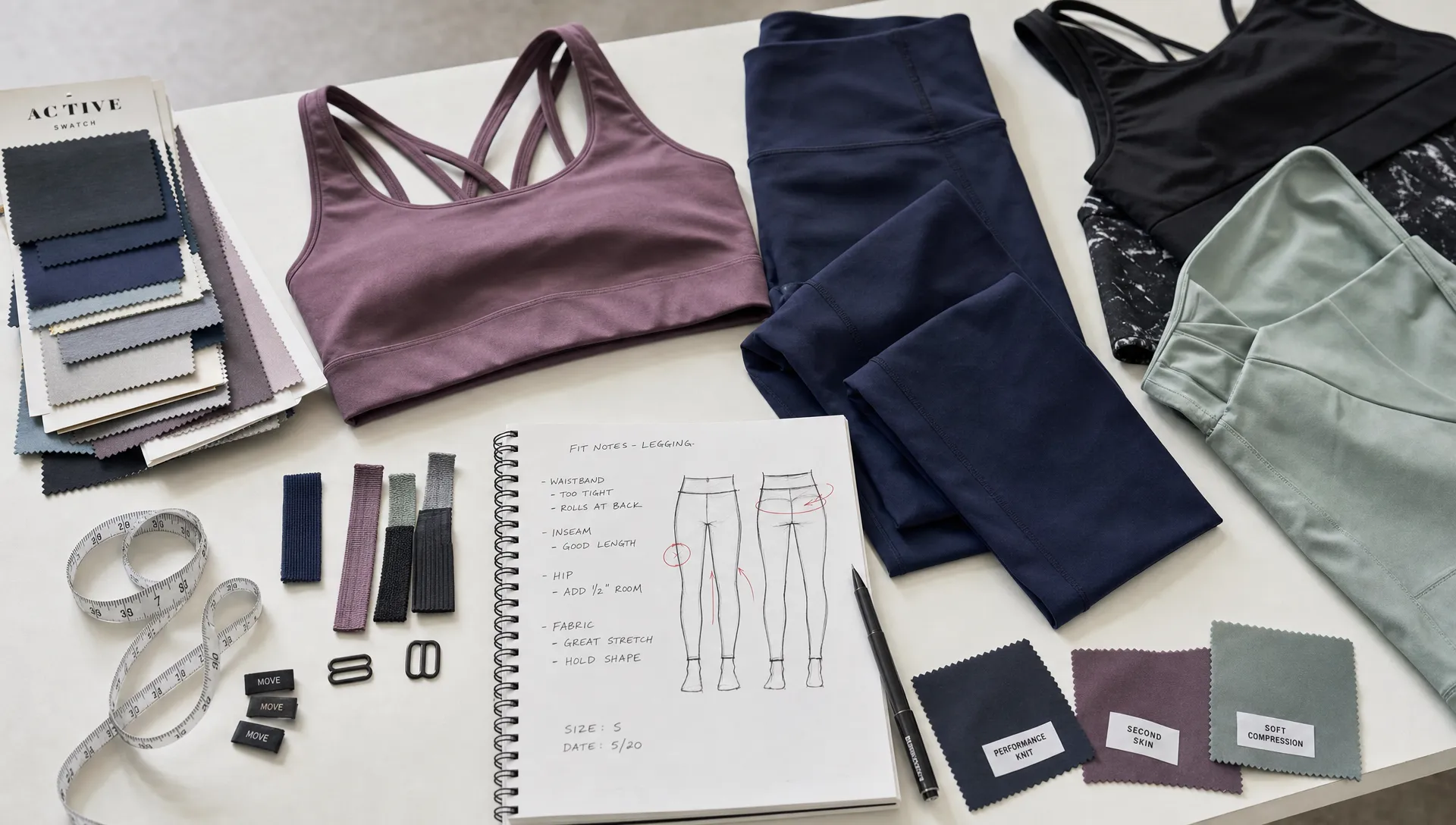
Useful fit feedback should be specific. Instead of noting that leggings feel uncomfortable, the reviewer should identify whether the issue is front rise, back rise, waistband height, elastic tension, gusset shape, seam placement or fabric recovery. Specific feedback leads to specific pattern corrections.
This is also where the right manufacturing partner matters. Development teams need pattern understanding, sample discipline and communication around fabric, grading and construction. The article on what workout clothing brands need from a manufacturer explains how production support affects the final customer experience.
Wear-test the product in real movement
A mirror fit session is not enough for activewear. Customers do not use leggings, bras, tees or joggers by standing still under studio lighting. They squat, run, stretch, sweat, sit, bend, commute, wash and wear the garment again.
A practical wear-test should include movement, time and laundering. Testers should wear the garment during its intended activity and record what changes after 30 minutes, after a full session and after washing. This helps identify issues that do not show up during a short fitting.
| Wear-test action | What it reveals |
|---|---|
| Deep squat | Opacity, waistband stability and gusset comfort |
| Lunges | Inseam movement, thigh compression and seam pressure |
| Jumping or running | Waist slip, bounce control and top stability |
| Overhead reach | Shirt length, armhole comfort and shoulder mobility |
| Sitting for 30 minutes | Front rise comfort, waistband pressure and fabric wrinkling |
| Washing and drying | Shrinkage, twisting, pilling, color stability and recovery |
The best insights often come from repeat wear. If a garment feels great for 10 minutes but bags at the knee after two hours, customers will remember the two-hour experience.
Make sizing easier for online shoppers
Even excellent fit can fail commercially if the customer cannot choose the right size online. Retention begins before checkout because sizing confidence affects the first purchase experience.
Women’s activewear brands should provide clear size charts that explain both body measurements and garment fit intention. A size chart for compressive leggings should not read like a size chart for relaxed joggers. Customers need to know whether to expect sculpting compression, soft support or a looser fit.
Product pages should also include model references, fit notes and activity guidance. Reviewing how activewear retailers organize collections, such as Cavalcade’s activity-based activewear shopping experience, can help brands think about how merchandising by use case supports better purchase decisions. When shoppers understand whether a product is intended for running, training or everyday wear, they can choose size and style with more confidence.
Strong sizing content usually includes:
- Body measurement chart: Bust, waist, hip, inseam and underbust where relevant.
- Garment measurement notes: Waistband height, inseam, rise, length and compression level.
- Fit guidance: Whether to size up for a relaxed feel or stay true to size for compression.
- Model information: Height, size worn and body measurements when possible.
- Customer review prompts: Ask reviewers to comment on fit, height, usual size and activity.
This information reduces the chance that customers order multiple sizes only to return most of them. It also helps customers feel that the brand understands real bodies.
Fix the details that create repeat complaints
Retention is often won or lost in small construction details. Customers may not know the technical reason a garment feels good, but they can feel the difference.
Waistbands are one of the biggest retention factors in women’s activewear. A waistband that rolls down during training can make the whole product feel unreliable. The fix may involve waistband height, elastic type, power mesh, seam placement, fabric recovery or grading. A high-rise waistband also needs enough back rise and proper contouring, not just extra height.
Gussets are another key detail in leggings and shorts. A well-placed gusset improves movement and comfort, while poor placement can create pulling, twisting or front-rise discomfort. Seam type matters too. Flat seams or carefully placed seams can reduce chafing in high-friction areas.
| Customer complaint | Likely cause | Development fix |
|---|---|---|
| Waistband rolls down | Poor contouring, weak recovery or elastic mismatch | Adjust waistband shape, tension and support layer |
| Leggings become sheer | Fabric too light or over-stretched in grading | Test opacity across sizes and colors |
| Shorts ride up | Inseam too short for activity or leg opening imbalance | Adjust inseam, leg opening and fabric recovery |
| Seams rub during workouts | Seam placement in high-friction zones | Review seam type and move pressure points |
| Tops twist after washing | Fabric torque or off-grain cutting | Check fabric stability and cutting alignment |
| Larger sizes feel different | Linear grading without body-shape review | Review grading rules and fit on multiple sizes |
These details should be solved before scale, not after customer reviews reveal the problem.
Approach inclusive sizing with real grading discipline
Inclusive sizing is a major opportunity, but it cannot be treated as simply extending the same pattern up and down. Bodies do not scale evenly. Bust, waist, hip, thigh, rise, shoulder and arm measurements change in different ways across sizes.
For smaller brands, low MOQ production can make inclusive testing more realistic. Instead of launching a very large size range across many styles, brands can test a focused capsule with strong fit validation. This helps identify demand while protecting cash flow and quality.
Brands selling across the USA, Canada, Europe, Australia, Germany, Poland and Brazil should also pay attention to regional sizing expectations. A medium in one market may not match customer assumptions in another. Conversion charts can help, but product-specific fit notes are more useful than generic international size labels.
Inclusive sizing works best when a brand creates fit standards, tests more than one size and treats larger or smaller sizes as real products, not afterthoughts.
Connect fit to private label manufacturing decisions
Fit is not created by design alone. It depends on pattern development, fabric sourcing, cutting accuracy, stitching, trims, print placement, wash behavior and final quality control.
For private label women’s activewear brands, manufacturing decisions should support the fit promise. If your brand promises sculpting leggings, the fabric, waistband and stitching need to support that promise. If your brand focuses on soft everyday athleisure, comfort, drape and recovery may matter more than maximum compression.
Extreme Sportswear supports custom sportswear, activewear, teamwear and private-label apparel production from Pakistan, including cut-and-sew manufacturing, sublimation printing, screen printing, custom embroidery, uniform manufacturing, fabric customization and packaging customization. For brands that need low MOQ orders and fast sampling, this type of production flexibility can help test fit before committing to larger runs.
| Development stage | Fit-related output | Retention impact |
|---|---|---|
| Design brief | Defines customer, activity and fit feeling | Aligns product promise with real use |
| Fabric selection | Confirms stretch, recovery and comfort | Reduces disappointment after wear |
| Pattern development | Builds the garment shape | Creates body confidence and consistency |
| Sampling | Tests corrections before bulk | Prevents avoidable fit complaints |
| Size set review | Checks grading across sizes | Improves trust across the size range |
| Quality control | Confirms measurements and construction | Keeps repeat orders consistent |
The strongest brands treat their manufacturer as a development partner, not only a supplier. Better communication early in the process usually leads to fewer fit issues later.
Track fit feedback after launch
Fit improvement does not stop once a collection goes live. The best women’s activewear brands build feedback loops from returns, exchanges, reviews, customer service messages and repeat purchase behavior.
A simple fit dashboard can track return reasons by style, size and region. If one legging style has a high exchange rate from medium to large, the waistband or hip grading may need review. If customers mention sheerness only in light colors, fabric opacity should be retested in those colors. If a top sells well once but has low repeat purchase, comfort or durability may be the hidden issue.
Useful retention metrics include repeat purchase rate by product category, return rate by size, exchange patterns, review language, customer service complaints and reorder demand for the same fit block. Over time, these data points show which fits deserve to become core products.
Retention improves when the customer can think, I know how this brand fits me. That confidence is built through consistency, not chance.
Frequently Asked Questions
How can women’s activewear brands improve fit quickly? Start with the highest-return or highest-complaint product, then review fabric recovery, waistband construction, grading and wear-test feedback. Fixing one core style can improve retention faster than redesigning the full collection.
What causes customers to stop buying from an activewear brand? Common reasons include inconsistent sizing, poor waistband stability, sheerness, chafing seams, fabric that loses shape and unclear online size guidance. These issues reduce trust even when the design looks attractive.
Should a new brand launch with a wide size range? A wide size range can be powerful, but only if it is properly graded and tested. Many new brands are better served by launching a focused range with excellent fit, then expanding sizes with real feedback and validated patterns.
How many sample rounds does an activewear style need? There is no fixed number. Most styles benefit from at least a prototype, fit sample, corrected sample, size set and pre-production sample. Complex garments or new fabrics may need additional rounds.
Can manufacturing choices improve customer retention? Yes. Fabric selection, pattern development, seam placement, trims, grading and quality control all affect how the garment feels after purchase. Consistent manufacturing helps customers trust future orders.
Build activewear customers want to buy again
Improving fit is one of the most practical ways to increase retention for women’s activewear brands. When customers feel supported, comfortable and confident, they are more likely to return for the next color, capsule or collection.
Extreme Sportswear helps brands develop custom activewear, private label apparel and teamwear with flexible production options, low MOQ orders and full customization support.