An accurate quote from a football jersey custom maker starts with a clear brief, not just a design image and an order quantity. Fabric, fit, decoration, size distribution and delivery terms all affect the price. When those details are missing, suppliers may quote different products even though they appear to be answering the same request.
Your brief does not need to be a professionally designed technical pack. A structured document with garment measurements, artwork references and a few explicit requirements can give a manufacturer enough information to price the work properly. The goal is to separate confirmed specifications from open decisions, then ask the supplier to identify any assumptions before you compare offers or pay for sampling.
What your football jersey custom maker needs to know first
Start by defining what “football” means for your order. American football jerseys worn over shoulder pads need different patterns and construction from soccer jerseys. Flag football, training and supporter jerseys can also require different fits.
State the intended use, whether the order is jersey-only or a complete uniform and whether adult and youth garments are included. For padded American football, describe the shoulder-pad fit and sleeve requirements rather than requesting a generic athletic cut.
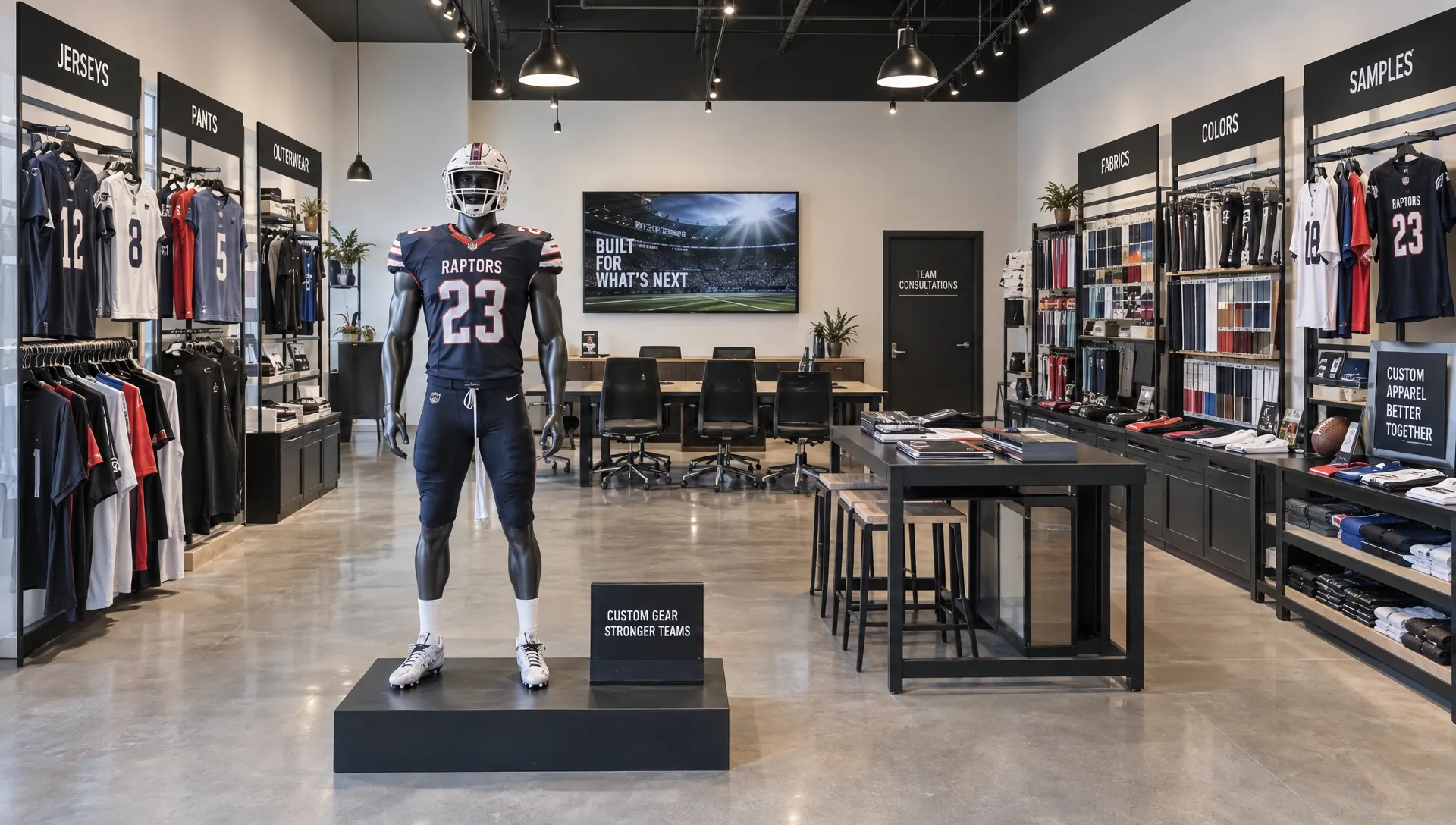
For this type of project, explore custom American football uniforms and specify which garments should be included in your quotation. Do not assume pants, accessories or matching practice wear are included in a jersey price.
Include the destination country, delivery postal code, and required arrival date. These details help the supplier distinguish manufacturing costs from freight and destination charges. Also identify whether the jerseys are for a club, school, league or retail collection, since branding and packaging requirements may differ.
State quantities by design, size, and player
“Quote 100 jerseys” leaves several pricing questions unanswered. A supplier needs to know whether that means one design in one colorway or several smaller production runs.
Give the total quantity and break it down by design, colorway and size. If the final roster is unavailable, label the size breakdown as provisional and ask when it must be locked. Flag extended sizes, youth sizes and goalkeeper or specialist variants separately.
Ask whether the minimum order quantity applies to the whole order, each design or each colorway. A low MOQ does not necessarily mean every combination can be produced at the same unit price.
Your football jersey custom maker also needs to know how many garments require unique names and numbers. State whether personalization covers every jersey or only selected units, and whether duplicate numbers are intentional.
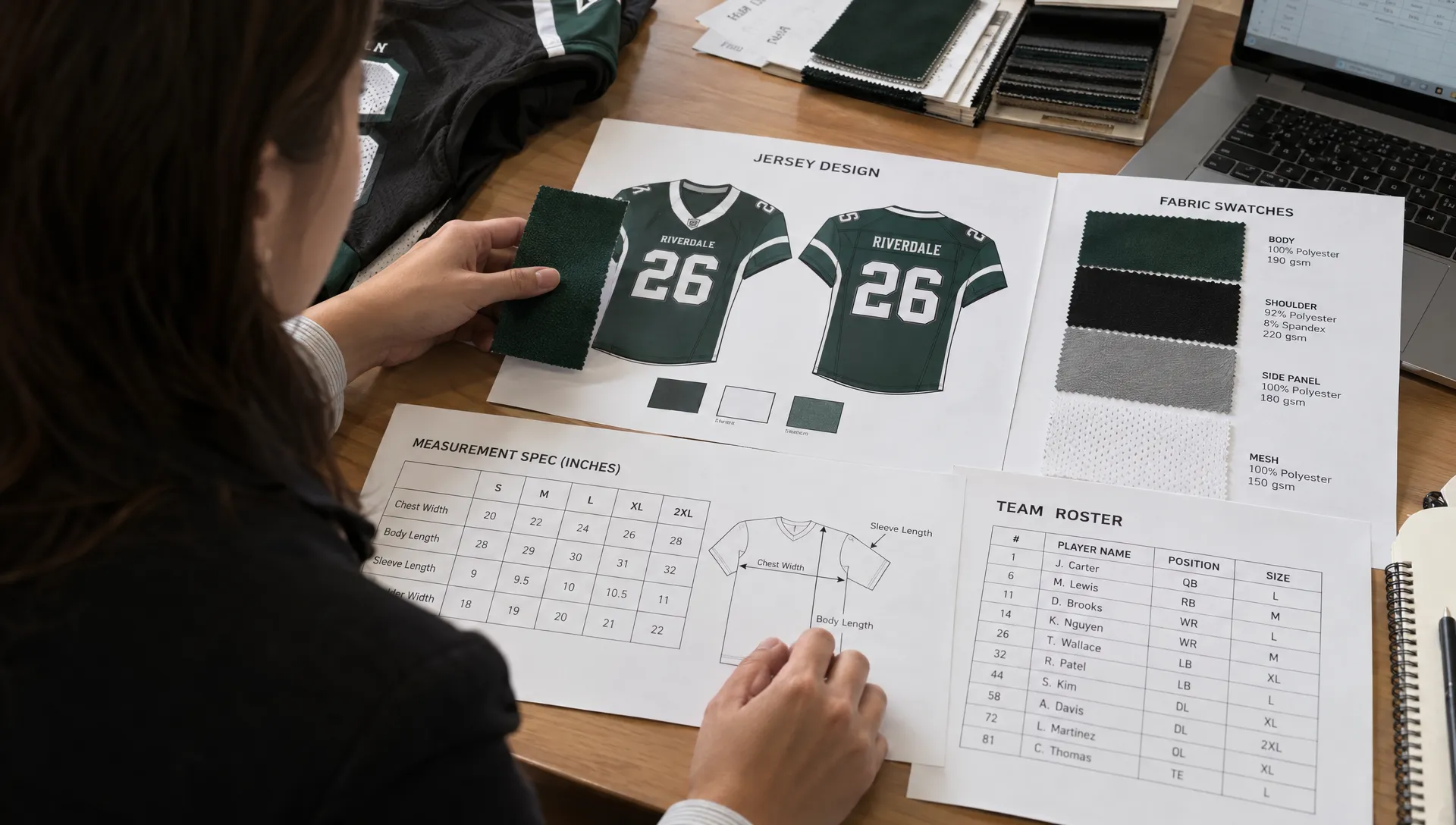
For fit, use finished-garment measurements rather than relying on S, M, and L labels alone. Identify the measurement method and units. For example, clarify whether chest width means a flat measurement across the garment or a full circumference. Ask the manufacturer to confirm measurement tolerances before sampling.
Specify fabric and construction in measurable terms
Descriptions such as “premium fabric” or “professional quality” do not define a product that two factories can price consistently. Provide measurable requirements where you have them, and request recommendations where you do not.
| Specification | What to include in the brief | Why it affects the quote |
|---|---|---|
| Fabric | Fiber composition, knit type and target weight in GSM, if known | Different materials and weights have different costs |
| Fit and pattern | Soccer fit, over-pads fit, youth fit or reference garment | Pattern development and fabric consumption can change |
| Panels | Mesh zones, contrast inserts or reinforced areas | Extra components add cutting and sewing work |
| Neck and sleeves | Collar shape, binding, cuffs and sleeve length | Construction and material requirements vary |
| Seams | Required reinforcement or reference construction | Additional sewing operations affect labor |
| Labels and packing | Brand labels, size labels, hangtags and individual bags | These may be priced separately |
Define artwork, decoration and personalization
Attach front and back artwork, plus sleeve and side views where relevant. Show logo locations, number dimensions and sponsor placements. Use measurements from identifiable garment points so positioning is not left to visual interpretation.
Supply editable vector artwork when available. Outline fonts or provide approved font files where licensing permits. Include color references and explain which colors need a physical approval sample, because a screen preview is not a reliable production color standard.
Your football jersey custom maker should confirm the decoration method used in the quotation. Sublimation, screen printing and embroidery involve different preparation and production steps, so “logos included” is not enough detail.
For sublimation, confirm the selected fabric is suitable and ask whether the quoted design covers all required panels. For screen printing, identify the number of colors and print locations. For embroidery, provide the proposed size and placement, then ask whether digitizing is included.
Keep the roster in a separate spreadsheet with one row per garment. Include size, player name and number, preserving accents, capitalization and leading zeros. Assign one person to approve the final file so conflicting versions do not reach production.
Separate sample timing from the delivery deadline
A lead-time estimate is useful only when its starting point is clear. Ask whether production time begins after payment, artwork approval, size confirmation, fabric availability or approval of the pre-production sample.
Give an actual required arrival date rather than “before the season.” If missing that date would make the order unusable, say so. Ask for separate estimates for sampling, revisions, bulk production and shipping, plus any assumptions about customs clearance.
Have your football jersey custom maker distinguish the factory-ready date from the expected delivery date. Completing production by your deadline does not mean the shipment will arrive by then.
Request sample charges, sample shipping costs and the policy on additional revisions. Confirm whether a sample fee is credited against a bulk order, rather than assuming it will be.
For international orders, request the shipping term and named place. The ICC’s Incoterms rules define responsibilities for delivery, costs and risk under the chosen rule. Ask who handles import clearance, duties and taxes, and identify the responsibilities that remain yours. Freight alone is not the complete cost of importing an order.
Compare the complete quotation, not just the unit price
Ask suppliers to separate recurring garment costs from one-time development charges. A useful quotation identifies the base jersey, personalization, labels, packaging, sampling, setup and shipping, either as line items or as explicitly included costs.
Record the currency, payment schedule, quote validity and conditions that could change the price. If quantities are still provisional, request pricing at the quantities you are genuinely considering rather than asking for an undefined bulk discount.
A football jersey custom maker offering a lower unit price may have excluded player names, artwork preparation or individual packing. That does not automatically make the offer unsuitable, but you need to add those costs before comparing it with an inclusive quote.
Use this comparison basis:
Comparable order cost = garments + required customization + development charges + packaging + freight + applicable import charges.
Treat recoverable taxes separately when assessing net cost. For cash planning, still establish what must be paid and when.
If one quotation proposes a different fabric or construction, request a compliant price alongside the alternative. A cheaper specification is a separate option, not a like-for-like saving. Keep a written list of exclusions, since “not mentioned” should never be interpreted as “included.”
Frequently asked questions
Can I get a quote without a technical pack? Yes. Clear garment references, artwork, quantities and a measurement chart can support an initial quote. Ask the supplier to list assumptions and mark the price as provisional until unresolved specifications are approved.
What should I send a football jersey custom maker first? Send the sport, order scope, quantity breakdown, design files, fit requirements and delivery destination. Include your arrival deadline and identify any decisions where you need a recommendation.
Should names and numbers be included in the unit price? They can be included or itemized separately. What matters is written confirmation of the method, locations and number of personalized garments covered by the price.
Why can the price change after sampling? Sampling may reveal changes in fabric consumption, construction, artwork or fit. Request a revised quotation showing each change, and approve it before bulk production begins.
Will a repeat order cost the same? Not necessarily. Quantity, material costs, artwork changes and freight can differ. Ask which development files will be retained and what minimum quantities apply to reorders.
Send a brief that can be priced accurately
Extreme Sportswear provides custom sportswear manufacturing, cut-and-sew production, sublimation printing, screen printing and embroidery. It also offers private-label production, low-MOQ orders, and fabric and packaging customization. Confirm the applicable minimums, sample arrangements, and production schedule for your specific project.
When your brief is ready, request a custom jersey quote from Extreme Sportswear with your specification document, artwork, quantity breakdown and delivery destination. Ask for an itemized response that separates confirmed requirements, proposed alternatives and exclusions so you can approve the order with fewer unresolved details.