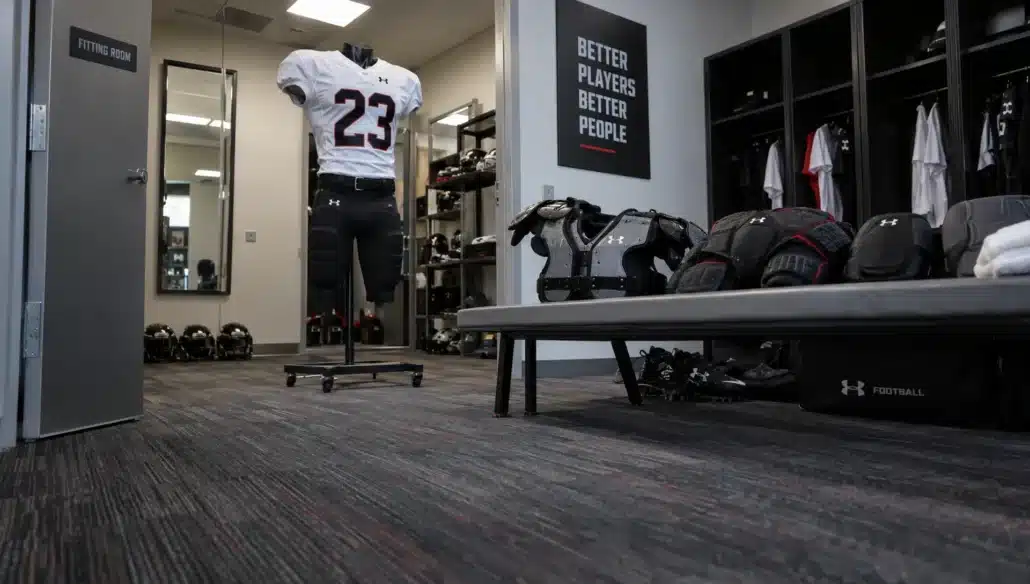
An American football uniform creator helps you plan colors, numbers and team branding, but a convincing preview does not prove that the uniform will fit over protective equipment. Shoulder pads change the jersey’s shape, while hip, thigh and knee protection affect how football pants sit and move.
For padded play, treat the creator as a design starting point rather than a fitting system. The reliable process is to select the right pattern, document the equipment players wear and test a physical sample before approving production. This guide explains how to turn an on-screen concept into a uniform that works in a football stance, not just on a digital model.
1. Start with a padded-football pattern
Before choosing a color scheme, establish what the template represents. A fan jersey, flag football top and padded tackle jersey can share similar graphics while requiring different patterns.
Ask whether the selected jersey pattern is intended to accommodate shoulder pads. Confirm the matching pants are designed for your chosen protection system, whether that means integrated pads, removable pads or a separate padded girdle.
An American football uniform creator should help communicate the intended garment, but its preview may not represent your supplier’s actual production pattern. Unless the platform explicitly provides validated fit simulation, do not assume a realistic-looking rendering predicts pressure, stretch or movement.
Record the pattern name or reference alongside the design. If the manufacturer proposes a different cut, request an explanation of the differences before approving it. A change in shoulder construction or sleeve length can affect both fit and artwork placement.
Keep one clear distinction: the design file describes appearance, while the approved pattern and measurements define fit.
2. Set up your American football uniform creator with useful measurements
Collect measurements using the manufacturer’s instructions. A chest circumference taken around the body is not interchangeable with a measurement taken over shoulder pads, and neither is the same as the width of a finished jersey laid flat.
Players should wear their intended base layer and correctly fitted equipment when equipment-on measurements are requested. Record which pad setup was used, especially when players have different shoulder-pad profiles.
| Measurement or reference | How to document it | What it helps establish |
|---|---|---|
| Body chest | Measure at the supplier’s specified level without shoulder pads | Starting point for the supplier’s size chart |
| Chest over equipment | Measure with the intended shoulder pads and base layer | Space needed around the padded torso |
| Shoulder-pad profile | Record the model and provide front and side reference photos | Shoulder shape and coverage requirements |
| Finished jersey dimensions | Use the supplier’s defined garment measurement points | Comparison with the proposed production pattern |
| Waist and hip | Follow instructions for measuring with or without a girdle | Pants sizing and protection compatibility |
| Inseam and knee position | Record the requested leg measurement and intended pad location | Pants length and knee-pad alignment |
When using an American football uniform creator, attach this measurement information to the design handoff rather than relying on a size label alone. One supplier’s large may not match another supplier’s large.
Avoid automatically ordering one size up for every player. Extra width can create loose fabric without solving a restrictive armhole or an unsuitable shoulder shape.
3. Check the jersey cut around the shoulders and arms
A padded jersey needs enough room where the equipment projects, but excess fabric is not a substitute for a suitable cut. Review the shoulder area, armholes, sleeves and torso as connected parts of the pattern.
The neckline should sit comfortably with the intended equipment. Shoulder and sleeve construction should cover the pads without pulling the collar out of position. Check that sleeve openings do not bind when the player reaches forward or assumes a blocking position.
Use the American football uniform creator to show your preferred silhouette, then ask the manufacturer how its pattern achieves that shape over pads. A close-fitting torso and a roomy shoulder area require deliberate pattern shaping, not simply a wider rectangle.
Jersey length also needs a practical check. A hem that looks adequate while standing may pull free when the player crouches or raises both arms. Assess the jersey together with the pants and intended tucking arrangement.
Fabric stretch can support movement, but it cannot reliably compensate for the wrong pattern. Ask the supplier to identify the proposed fabric and stretch direction, then assess the actual material in the sample rather than judging performance from a digital texture.
4. Design the pants around the protection system
Football pants should be evaluated with the protection players will actually wear. Integrated-pad pants, pants with removable pad pockets and pants worn over a padded girdle do not create identical fitting requirements.
Confirm what protection the pants themselves contain and what must be supplied separately. Do not assume that a product described as padded includes every item required by your competition.
Your American football uniform creator may show the pants’ exterior without revealing the internal arrangement. Include the intended pad system in the written specification so the manufacturer can assess waistband construction, pocket placement and available room.
Pay particular attention to knee coverage. During a squat or lunge, check whether the knee pad stays positioned over the knee and whether the pant leg twists or pulls it away. A pants length chosen only for appearance can interfere with that alignment.
The waistband should stay secure without depending on excessive tightening. Check the seat and crotch during a football stance, too. Restriction in these areas may require a pattern adjustment rather than a larger waist size.
Never trim protective equipment or alter its fit to make a uniform sample look better. Resolve garment problems through the garment specification.
5. Position artwork on the padded shape
Once the cut is established, review the design on front, back and side views. Shoulder pads change the visible surface of a jersey, so artwork that looks centered on a flat template can appear displaced when worn.
Place numbers and logos with the actual seams and panel boundaries in mind. Confirm which parts of a shoulder stripe remain visible over the pads and whether a sleeve mark rotates out of view when the player moves.
An American football uniform creator is particularly useful for comparing these placements, provided you also check them against the manufacturer’s pattern. Ask for finished artwork dimensions and placement references rather than approving only a screenshot.
For sublimation, the printed design still needs to align with the cut panels. Where embroidery, patches or other applied decoration are proposed, ask whether their position or backing affects a stretch area or creates discomfort beneath equipment.
Check the current requirements of the competition governing your team. For US college programs, the NCAA football rules resources are a relevant starting point, but other leagues may use different requirements.
For the separate task of organizing player details, follow a consistent process for personalized football jersey names and numbers. Keep roster approval distinct from padded-fit approval so a correct spelling does not get mistaken for a complete production sign-off.
6. Turn the preview into a production brief
A manufacturer needs more than the finished visual. Combine the design with a short technical brief that connects appearance, construction and fit.
Identify the approved jersey and pants patterns, proposed fabrics, protection setup and measurement chart. Include front and back artwork, relevant side views and any placement dimensions agreed with the supplier. State whether measurements describe the player, the player wearing equipment or the finished garment.
The American football uniform creator file should be one part of this package, not the only production reference. If the tool cannot export editable artwork, ask the manufacturer what source files or redrawn proofs are needed before sampling begins.
Use a clear version name for each revision. If you shorten the sleeve or change a panel, review the graphics again because the printable area may have changed. Keep the approved sample linked to the final specification rather than an earlier mockup.
Before bulk production, agree how garment measurements will be checked and what tolerances apply. Those tolerances should come from the manufacturer’s documented process and your approval, not an arbitrary allowance copied from another garment.
For a manufacturing review, request a quote for custom American football uniforms with your design, equipment details, size breakdown and sample requirements. This gives the supplier a clearer basis for discussing feasibility and cost.
7. Approve a sample through movement, not appearance alone
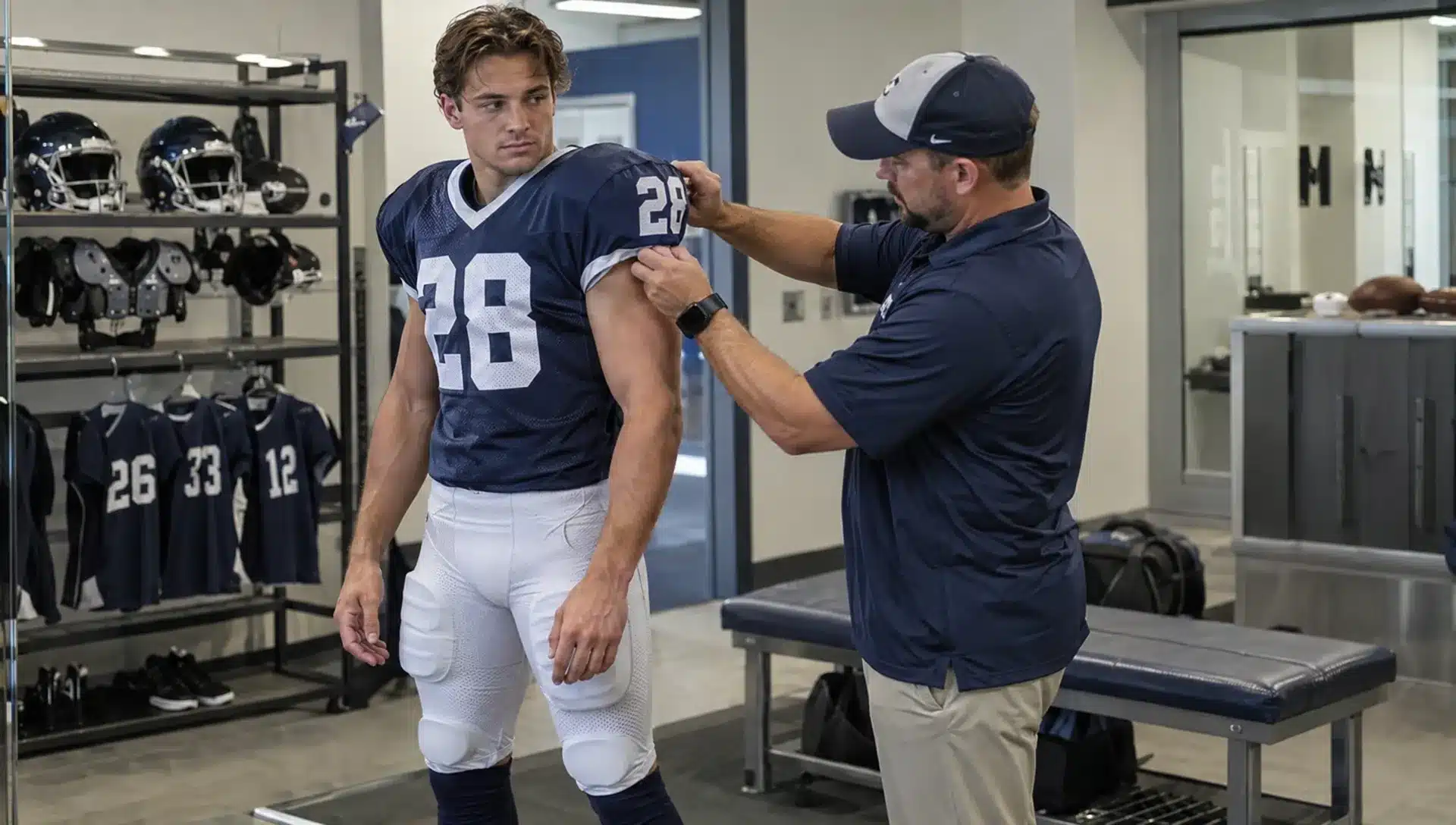
Review a physical sample made in the proposed fabric and construction. A visual proof can confirm colors and layout, but it cannot establish whether the neckline pulls, the pants twist or the shoulder area restricts movement.
Have the player wear the intended base layer, correctly fitted pads and any separate girdle. Begin with a standing inspection, then move through controlled, noncontact football positions.
- Football stance: Check the seat, crotch, waistband and jersey hem for pulling or displacement.
- Forward reach: Look for restriction across the shoulders, armholes and upper back.
- Overhead reach: Check whether the collar shifts or the jersey pulls excessively out of the pants.
- Squat and lunge: Confirm that the pants allow movement and knee protection remains properly positioned.
- Return to standing: Check whether the garment settles back without repeated adjustment.
Record problems with photos and specific descriptions. “Back neckline pulls during forward reach” gives the manufacturer more useful information than “the jersey feels wrong.”
Return to the American football uniform creator when a fit correction affects the visible design, such as moving a seam or changing sleeve length. Update the artwork and specification together.
For a roster spanning substantially different sizes or pad profiles, discuss whether additional fit samples are needed. One sample cannot establish that every size fits correctly. After any agreed care test, recheck dimensions and appearance according to the proposed care instructions before final approval.
Frequently asked questions
Can an online uniform preview prove the jersey fits over shoulder pads? No. Unless the tool explicitly provides validated fit simulation for the relevant garment and equipment, treat it as a visual reference. Confirm padded fit using measurements, the supplier’s pattern and a physical sample.
Should every player order a larger jersey for padded football? Not automatically. A purpose-built padded pattern may already include the required room. Follow the manufacturer’s measurement method and check the sample rather than applying a blanket size increase.
Can the same design be used for padded football and flag football? The branding can be adapted, but the garment patterns may need to differ. An American football uniform creator can help retain the visual identity while you prepare separate specifications for padded and unpadded use.
What should we send the manufacturer first? Send the design views, intended competition, quantity by size, equipment setup and available measurements. Ask which pattern and sample process the manufacturer recommends before treating the mockup as production-ready.
Does a good uniform fit replace protective-equipment fitting? No. Uniform approval and protective-equipment fitting are separate checks. Follow equipment manufacturers’ instructions and your team’s applicable safety procedures.
Move from mockup to a tested padded fit
Extreme Sportswear offers custom sportswear manufacturing, cut-and-sew production, sublimation printing and custom embroidery. Its sampling and low-MOQ options can be discussed against your team’s design and order requirements.
Bring the mockup together with your measurements, pad setup and fit-test notes, then contact Extreme Sportswear to start your uniform manufacturing enquiry. Ask for confirmation of the proposed pattern, sample scope and approval process before committing the full roster to production.