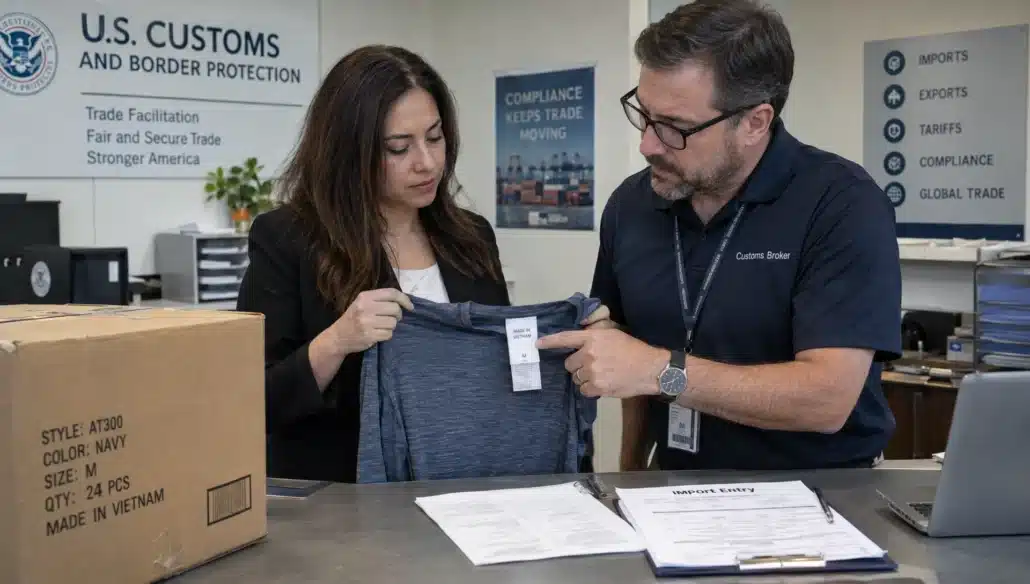
A custom logo does not make private label athletic wear ready for US sale. Before your leggings, training shirts or team uniforms reach customers, their labels generally need accurate fiber content, country of origin, responsible business identification and care instructions. Missing information can create problems at import, force relabeling or leave shoppers with misleading product claims.
For brands sourcing from Pakistan or another overseas manufacturing market, the practical challenge is coordinating several requirements on a small label without sacrificing comfort. A removable hangtag, branded neck print and permanent care label serve different purposes. This guide explains the common federal requirements for textile athletic apparel and how to build them into your production approval process. Specialty products and state-specific obligations may require additional review.
What private label athletic wear labels must show
Most ordinary textile athletic garments fall under the Federal Trade Commission’s Textile Rules and Care Labeling Rule. Imported goods also face US Customs and Border Protection marking requirements.
| Information | General requirement | Practical implication |
|---|---|---|
| Fiber content | Generic fiber names and percentages by weight, subject to applicable rules and exceptions | Use verified composition, not a fabric trade name alone |
| Country of origin | The garment’s legally determined manufacturing origin | Identify the actual country, not simply the shipping location |
| Responsible business | An eligible business name or FTC Registered Identification Number | A decorative brand logo may not be enough |
| Care instructions | A safe regular care method, with necessary warnings | Instructions generally belong on a permanent label |
| Size and style details | Not generally part of these core federal textile disclosures | Useful for customers and inventory but not substitutes for required information |
The FTC’s guide to textile and wool labeling requirements explains the main disclosures, placement rules and exceptions.
These obligations do not disappear because an order is small, sold through social media or marketed under your own brand. Manufacturer-applied labels still need to match the garment your business actually sells.
Declare fiber content using the correct names
For private label athletic wear, start with the finished fabric specification rather than a supplier’s marketing description. Terms such as “performance stretch,” “cool-touch fabric” and “compression blend” do not identify fiber composition.
A typical declaration might read 88% polyester, 12% spandex, provided reliable records support those percentages. Fibers are generally listed in descending order by weight using their recognized generic names. A trademark cannot replace the generic fiber name.
Handle stretch fibers, panels and wool carefully
The treatment of fibers below 5% has exceptions. Such fibers are generally grouped as “other fiber” or “other fibers,” but a fiber with definite functional significance may be identified by name and percentage. A small amount of spandex providing stretch can therefore need different treatment from an incidental fiber. Wool has its own disclosure rules, even at low percentages.
Color-block panels, mesh inserts and linings also deserve attention. Depending on the garment and applicable exceptions, separate sections may require separate composition disclosures. Do not assume that one fabric certificate describes every component.
Ask for the bill of materials and supporting composition records before approving artwork. If different colorways use different fabric constructions, check each one. Substituting a fabric after label approval can make an otherwise accurate label incorrect.
Establish origin before writing “Made in”
The country that ships the order is not automatically the country of origin. Nor does adding a US brand name, designing the collection in America or applying a logo domestically make an imported garment US-made.
For private label athletic wear produced across multiple countries, origin should be determined from the actual manufacturing steps. US apparel origin rules include product-specific provisions involving assembly and knit-to-shape production. The relevant framework is in 19 CFR 102.21.
If the correctly determined origin is Pakistan, the label can state Made in Pakistan. Do not replace that disclosure with “Imported,” “Designed in USA” or the address of your brand’s US office.
Review US references on imported garments
US city names, addresses and statements such as “Designed in California” can create additional marking issues. Depending on the wording and context, CBP may require the actual country of origin nearby and in comparable lettering. Review proposed artwork against CBP’s country-of-origin marking rules, especially when US references appear on labels or packaging.
Separately, an unqualified “Made in USA” claim must meet the FTC’s all or virtually all standard. The agency’s Made in USA guidance explains why domestic branding or minor finishing alone is insufficient.
Have your customs broker review uncertain origin determinations before bulk labels are ordered.
Identify the responsible business correctly
A fiber label generally needs the name of the manufacturer or another business responsible for marketing or handling the product, or an eligible FTC Registered Identification Number, commonly called an RN.
When labeling private label athletic wear, distinguish between your consumer-facing logo and the business identification required by the rules. A logo by itself may not identify the responsible business adequately. Use a qualifying business name or a valid RN, rather than assuming any brand graphic will work.
An RN is an alternative to a business name, not a universal requirement. The FTC issues RNs to eligible US businesses. A foreign manufacturer cannot obtain one simply because it exports garments to the United States, although an appropriate foreign business name can be used under the labeling rules.
Check ownership before printing an RN supplied by an agent, previous factory or packaging vendor. It should identify the business intended to appear on the garment, not an unrelated company.
Resolve this during supplier onboarding. Our guide to choosing a private label activewear manufacturer provides a broader framework for assessing specifications, sampling and production communication.
Make care instructions permanent and supportable
A removable hangtag generally cannot replace the permanent care label required for covered apparel. The label must remain attached and legible throughout the garment’s useful life. Textile identification labels have different durability requirements, so do not treat every disclosure as if it follows the same attachment rule.
For private label athletic wear, care instructions should reflect the complete garment, including stretch fabric, printing, embroidery, trims and heat-applied decoration. A blank fabric may tolerate a treatment that damages the finished product.
The FTC Care Labeling Rule guidance explains the need for a reasonable basis for instructions. Those instructions must provide a safe regular care method and necessary warnings. That basis can include relevant testing and other reliable evidence, not simply a factory’s default wording.
Check placement and symbols
For garments with a neck, FTC rules generally place country-of-origin information on the front of a label at the inside center neck or close to another label there. Neckless garments, such as leggings, follow different placement provisions. Other required textile information may appear elsewhere as permitted.
A tagless print is not automatically compliant or noncompliant. Its location, readability and durability matter. Care information can appear on a separate permanent label.
Symbols alone are permitted only when they meet the Care Labeling Rule’s recognized symbol requirements. Do not assume symbols prepared for a European collection automatically satisfy US rules. Required disclosures should be in English, with additional languages included where appropriate.
A sample label layout to review with your supplier
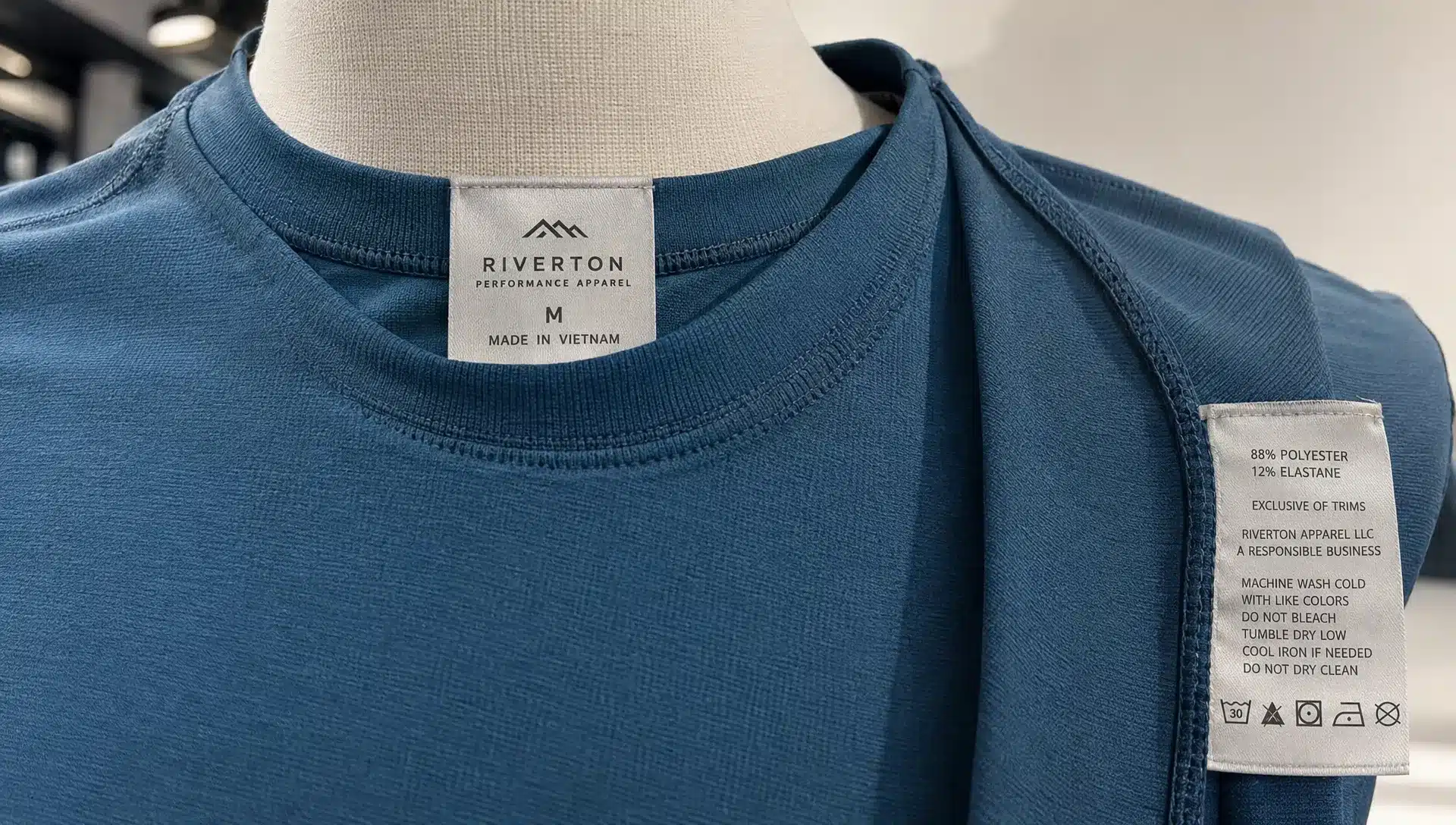
A label specification for private label athletic wear should separate required disclosures from optional merchandising details. The following example is illustrative only. Its composition, origin and care instructions must all be verified for the actual garment.
88% Polyester
12% Spandex

Made in Pakistan
[Qualifying business name or valid FTC RN]

Machine wash cold.
Do not bleach.
Line dry.
Do not iron.

Size M
Style AT-104
This text does not establish the correct physical placement. A training shirt may need origin information at the neck while carrying care instructions in a side seam. A pair of shorts may use a different label arrangement.
The size and style code are useful operational details, but they do not replace mandatory disclosures. Likewise, a style code alone is not a complete children’s tracking label.
Keep online listings and packaging consistent
An accurate sewn label does not excuse an inaccurate product page. Internet sales fall within the Textile Rules’ advertising provisions, including disclosure of whether covered goods are US-made, imported or both, as applicable.
For private label athletic wear listings, displaying the specific country of origin is a straightforward way to give customers clear information. A listing for a Pakistan-made garment should not imply US manufacture through headings, flags or unsupported statements.
Keep composition claims synchronized too. If the approved label says 88% polyester and 12% spandex, the website should not describe the same item as “100% recycled polyester.” A recycled-content claim needs its own support and must not misrepresent the complete blend.
Packaging should not conceal or contradict mandatory information. Where packaging prevents customers from seeing a required label, additional labeling obligations may apply.
A QR code can provide extra care guidance or traceability details, but it should not replace required physical disclosures. Treat it as supplementary information rather than a substitute for the sewn label.
Check safety obligations beyond textile labeling
Label accuracy is one part of product compliance. It does not demonstrate that a garment meets flammability requirements or other applicable safety standards.
Adult apparel and flammability
Many ordinary apparel textiles are subject to the federal flammability standard for clothing textiles, 16 CFR Part 1610. Testing exemptions exist for certain fabrics, but an exemption should be established from the actual material and construction.
When importing private label athletic wear, determine the applicable testing and certification requirements before shipment. Do not infer compliance solely from “performance fabric,” a familiar fiber name or a report for a different product.
Children’s athletic clothing
Products intended primarily for children age 12 or younger can trigger additional Consumer Product Safety Improvement Act obligations. Depending on the item, these can include lead limits, third-party testing and a Children’s Product Certificate.
Children’s products also generally need permanent tracking information on the product and packaging, to the extent practicable. Required information includes the manufacturer or private labeler, production location and date, batch or other identifying details sufficient to establish the specific source.
Children’s sleepwear follows separate flammability rules. Calling a product a “lounge set” or “training set” does not by itself settle its classification. Review intended use, design and marketing before placing it in an ordinary sportswear compliance process.
State chemical restrictions and warning requirements may also apply independently of federal textile labels.
Build label approval into production control
The most useful compliance document is a style-specific label specification tied to the approved garment. Generic instructions such as “use standard US labels” leave too much open to interpretation.
Before approving private label athletic wear for bulk production, complete these checks:
- Verify the materials: Match the composition declaration to the fabric specification and any separately disclosed garment sections.
- Confirm origin and identity: Record the origin determination and approve the exact business name or RN.
- Substantiate care: Review evidence supporting the instructions for the decorated, finished garment.
- Approve the physical sample: Inspect wording, location, attachment, readability and label comfort.
- Control production changes: Require renewed approval when fabric, decoration, sourcing or care instructions change.
- Align sales information: Check product pages, packaging and import documentation against the final approved specification.
Ask to see the actual labels attached to the pre-production sample, not only a digital artwork file. For heat-transfer labels, assess durability using conditions relevant to the stated care method. For sewn labels, check that attachment does not compromise comfort or stretch.
Keep dated artwork approvals, material records and relevant test documentation. During bulk inspection, compare finished units against the approved sample and check more than one size or colorway.
Reviewing a supplier’s athletic wear product range can help identify which styles need different label placements, but each selected construction still needs its own approval.
Frequently asked questions
Does private label athletic wear need an RN for US sales? No. An eligible business name can generally be used instead. An RN is an FTC-issued identification option for qualifying US businesses, not a mandatory registration for every clothing brand.
Can all required information go on a hangtag? Generally not. Covered apparel needs permanent care instructions, and origin marking has its own placement and attachment requirements. A hangtag can supplement the garment labels but should not be treated as their automatic replacement.
Can I replace the factory label with my own branding? Yes, provided the finished garment retains accurate required disclosures in compliant locations. Relabeling must not remove necessary origin, fiber, business identification or care information without properly replacing it.
Are size labels required by federal textile labeling rules? Size is not generally one of the core disclosures required by those rules. Brands commonly include it for usability and inventory control, but it does not replace the required textile information.
Who should confirm compliance before a US shipment? Assign responsibilities between the brand, manufacturer and importer. Use a customs broker for origin and marking questions and a qualified compliance adviser or laboratory for applicable safety requirements. Outsourcing label production does not automatically remove your business’s obligations.
Discuss label requirements before sampling
Extreme Sportswear offers Pakistan-based custom sportswear manufacturing, private-label production, cut-and-sew services and fabric and packaging customization. Share your destination market, garment specifications and proposed label artwork early so labeling requirements can be discussed alongside the sample.
Bring confirmed compliance requirements to that conversation rather than waiting until the order is packed. This gives your team an opportunity to review wording, placement and construction before bulk production.
Discuss your custom athletic wear order with Extreme Sportswear and include your US label specifications with the inquiry.