A fitness apparel designer needs more than a mood board and a logo to turn your activewear concept into a repeatable product. Your tech pack should explain how the garment looks, fits, performs and gets approved, with enough detail that a pattern maker, sample room and production team can work from the same instructions.
For a leggings launch, that means defining details such as waistband construction, stretch direction, pocket placement and measurement methods. For a training shirt, it might mean clarifying sleeve movement, ventilation panels and print placement. Attractive sketches alone cannot settle those decisions.
Use the following framework to build a working development document, then update it as samples are reviewed. The goal is not to specify everything perfectly on day one. It is to make decisions visible and prevent unresolved details from becoming production assumptions.
What a fitness apparel designer needs before sampling
Start with a cover page that identifies the style name, unique style code, revision date, sample size, intended size range and development stage. Include the person responsible for approving changes so questions reach the right decision-maker.
Next, describe the garment’s intended use and fit. “Women’s leggings” is too broad. A high-waisted training legging intended for strength workouts needs a clearer brief covering waistband support, coverage during movement and pocket requirements.
If you have not settled those choices, first clarify your range using this guide to choosing the right fitness apparel for your brand.
Mark each specification as confirmed, proposed or awaiting approval. Before sampling, your fitness apparel designer should know which details are fixed and which require development, rather than having to infer that distinction from scattered messages.
Technical drawings that explain construction
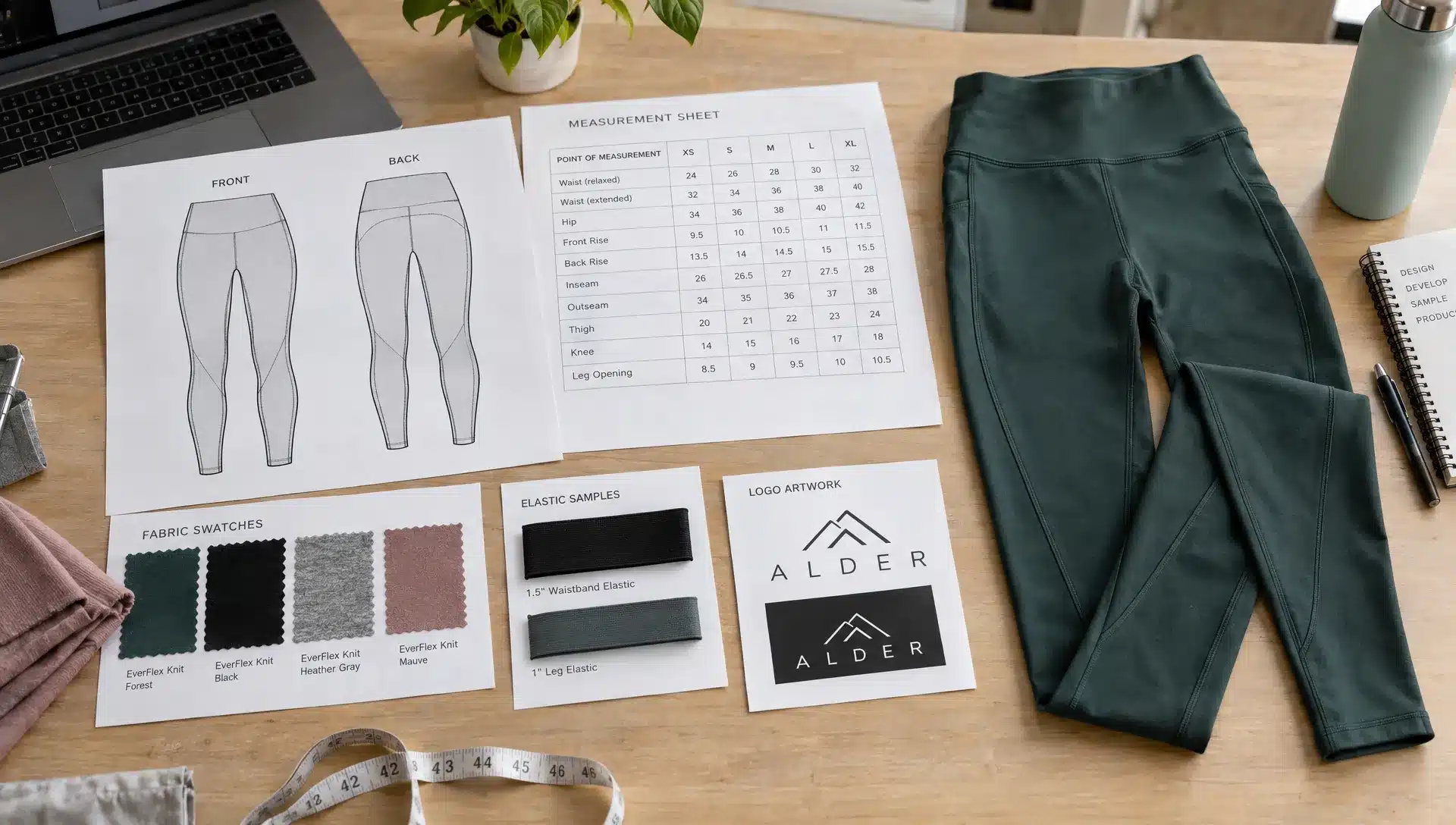
Include front and back technical flats, plus interior views or close-ups wherever the construction cannot be understood from the outside. Fashion illustrations can communicate a concept, but production drawings need to show panel boundaries, seams and component placement.
Reference images help explain an idea, but they should not replace specifications. Annotate the exact feature you want to reference, such as a waistband shape or pocket opening, rather than asking the factory to reproduce an entire garment.
Useful drawing callouts include:
- Panel construction: Identify gussets, mesh inserts, lining pieces and reinforcement areas where applicable.
- Seam and stitch requirements: Specify the proposed seam construction and stitch type, then confirm suitability during development.
- Finishing details: Show hem construction, binding, elastic attachment and any exposed seam finishes.
- Functional components: Define pocket openings, closures, drawcord routes and attachment positions with dimensions.
Avoid instructions such as “premium stitching” or “comfortable seams.” Neither tells the sample room what to make. Describe the construction, then assess its comfort and durability on the sample.
Your fitness apparel designer should also connect drawing callouts to the relevant material and measurement references, making it possible to trace each feature across the pack without guessing.
A bill of materials with identifiable fabrics and trims
The bill of materials, or BOM, lists everything required to make the garment. Include the main fabric, secondary fabrics, elastic, thread, closures, labels and decoration components. Assign each item a reference that matches the technical drawings.
For fabric, record composition, knit or weave structure, weight in grams per square meter, color reference and supplier or approved material code when available. Note stretch direction and any required finishing treatments. Keep fabric width and expected shrinkage visible where they affect cutting or pattern development.
Composition and fabric weight do not establish performance by themselves. Two fabrics with the same fiber percentages can behave differently because of yarn, construction and finishing. Where stretch, recovery or opacity matters, document the evaluation method and approval criteria instead of relying on descriptions such as “four-way stretch” or “squat-proof.”
Trim entries need comparable detail. Define elastic width and construction, zipper length and type or the dimensions of a woven label. State who supplies each component and whether substitutions require approval.
A fitness apparel designer needs an identifiable material reference, not just “soft black performance fabric,” to assess whether later samples match the original development choice.
If material choices remain unresolved, discuss your fabric and sampling requirements with Extreme Sportswear before treating the BOM as final.
Measurement specifications, tolerances and size grading
Your measurement sheet needs named points of measure, or POMs, with diagrams showing exactly where and how each measurement is taken. Specify units and measurement conditions, including whether the garment is relaxed, stretched or measured after an agreed wash procedure.
For a legging, a measurement-method table might include the following. These are fields to define, not recommended dimensions for every product.
| Point of measure | Method to define in the pack | Detail that prevents ambiguity |
|---|---|---|
| Relaxed half-waist | Measure straight across the waistband while laid flat | State whether the top edge or another reference line is used |
| Stretched waistband | Measure using an agreed extension or applied force | Record the method separately from the relaxed measurement |
| Front rise | Follow the defined front path from crotch junction to waistband edge | Clarify whether waistband height is included |
| Inseam | Measure along the inseam from crotch junction to hem | Show the start and end points on a diagram |
| Thigh width | Measure across the leg at a stated distance below the crotch | Keep the reference distance consistent across sizes |
Add the approved sample-size value, tolerance and grading information for each relevant POM. Tolerances should reflect fit sensitivity and manufacturing capability, not a single allowance copied across every measurement.
Your fitness apparel designer should distinguish body measurements from finished garment measurements, particularly when stretch garments use negative ease. The relationship between them needs fit validation, not assumptions based on a size label.
Grade rules must also be explicit. Do not assume every dimension increases equally between sizes; pocket positions, rise lengths and waistband proportions may require separate decisions to preserve fit.
Artwork, labels and packaging specifications
Provide production-ready artwork separately from reference mockups. Vector files are useful for suitable logo applications, while raster artwork needs appropriate resolution at the intended output size. Confirm file requirements with the production team before approval.
Specify decoration method, finished dimensions, color references and placement measured from fixed garment landmarks. “Logo on the left chest” leaves too much interpretation. Also state whether placement stays constant across sizes or follows a defined adjustment.
Screen printing, sublimation and embroidery have different material and construction considerations. Confirm the proposed method against the selected fabric, stretch requirements and seam layout before committing to bulk production.
Labels need their own artwork and content approval. For US sales, the FTC’s guidance on textile labeling requirements is a useful starting point. Verify applicable care-label, language and destination-market requirements separately rather than assuming one label works everywhere.
Include packaging requirements such as folding method, bag dimensions, size identification and carton assortment where relevant. Your fitness apparel designer should be able to distinguish approved branding files from visual placeholders that must not reach production.
Performance checks and sample approval criteria
A tech pack should explain how you will decide whether the sample works. Replace broad promises such as “high performance” with product-specific checks and documented acceptance criteria.
For leggings, assess coverage during relevant movements, waistband movement, seam comfort, pocket security and recovery after stretching. For a training top, evaluate overhead reach, armhole restriction, hem movement and rubbing during use. Sports bras require fit and support evaluation appropriate to their intended activity and size range.
Record the test conditions. Opacity observations can change with garment size, fabric extension and lighting. Wash assessments need an agreed procedure and number of cycles. Without consistent conditions, two sample reviews may produce conflicting conclusions.
A practical approval plan separates three areas:
- Fit and movement: Review the intended fit on appropriate wearers and check the garment during its intended activity.
- Material and construction performance: Evaluate relevant issues such as dimensional change, color transfer, seam damage and fabric recovery using agreed methods.
- Appearance and execution: Check workmanship, color, measurements, decoration and labeling against approved references.
Set criteria with the manufacturer and, where appropriate, a qualified testing provider. Formal product claims need suitable evidence; a successful informal wear test does not substantiate every marketing claim.
Your fitness apparel designer should receive sample feedback as specific observations, photographs and measurement results. “Waistband feels loose after movement” is useful; “make it better” is not an actionable revision.
Version control and a clean factory handoff
Put the style code, revision identifier and date on every page. Keep a revision log explaining what changed, why it changed and whether approval is still pending. This is especially valuable when teams work across different countries and time zones.
Send a consolidated pack rather than spreading specifications across email threads, messaging apps and separate attachments. Include an accessible PDF for review, with editable artwork and other source files supplied separately where needed. Agree on which document controls if conflicting information is found.
After each sample round, update the relevant specification instead of adding a comment that contradicts an older value. Link fit photographs and review notes to the sample identifier so the factory knows which garment was assessed.
Before authorizing bulk production, confirm the agreed approval status of the material references, measurements, construction, artwork and packaging. The approved pre-production sample should correspond to the current pack, with any exceptions recorded explicitly.
A fitness apparel designer should never have to choose between two apparently final measurement sheets. Archive superseded files and make the current release easy to identify.
Clear documentation also supports the broader product development expectations brands should set with a manufacturer. A tech pack can communicate requirements, but both parties still need to agree on responsibilities, feasibility and approval steps.
Frequently asked questions
Can I start sampling without a complete tech pack? You can begin exploratory development with an incomplete pack if missing details are clearly identified. A dependable quotation or production approval requires more resolved information, so document assumptions and update the pack as decisions are made.
Should I include measurements for every size? Include the base-size specification and agreed grading information, or a complete graded measurement chart. Do not leave the factory to invent the relationship between sizes. Review additional sizes where fit risk warrants it.
Can a fitness apparel designer create the tech pack from sketches? A fitness apparel designer can develop sketches into a tech pack, but will still need decisions about intended use, fit, materials, branding and approval criteria. Clarify which development tasks are included in the engagement.
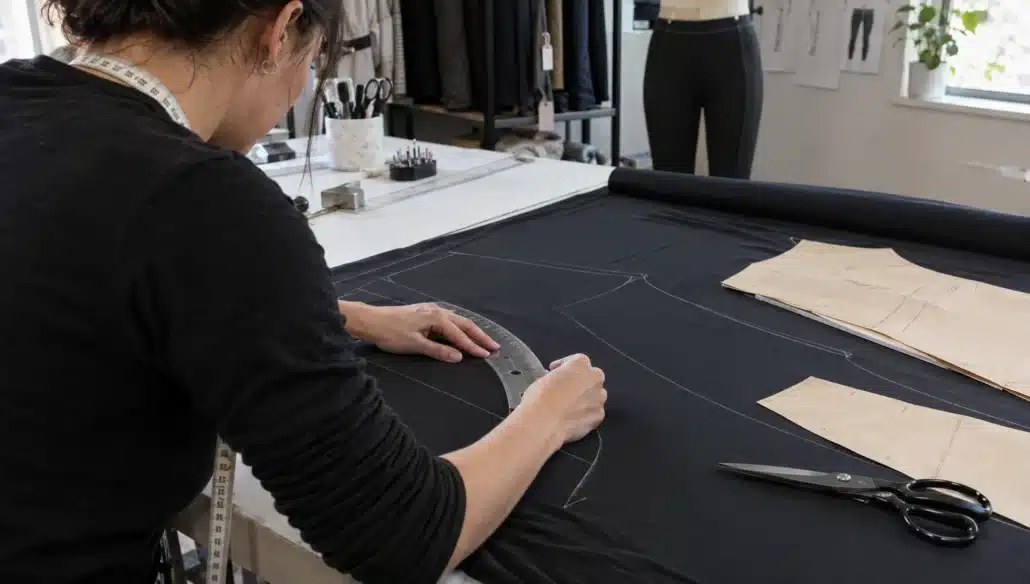
Is a tech pack the same as a sewing pattern? No. The tech pack communicates product specifications and approval requirements. Sewing patterns define the shapes used to cut the garment pieces. They must remain aligned as the product develops.
Move from your tech pack to a sampling discussion
Extreme Sportswear offers custom sportswear and private-label manufacturing in Pakistan, including cut-and-sew services, fabric and packaging customization, sublimation, screen printing and embroidery. Low-MOQ orders and fast sampling are also part of its offer.
Share your current tech pack, intended quantities, target size range and unresolved development questions. Ask the team to confirm material options, decoration feasibility, sampling requirements and any specifications that need clarification before work begins.