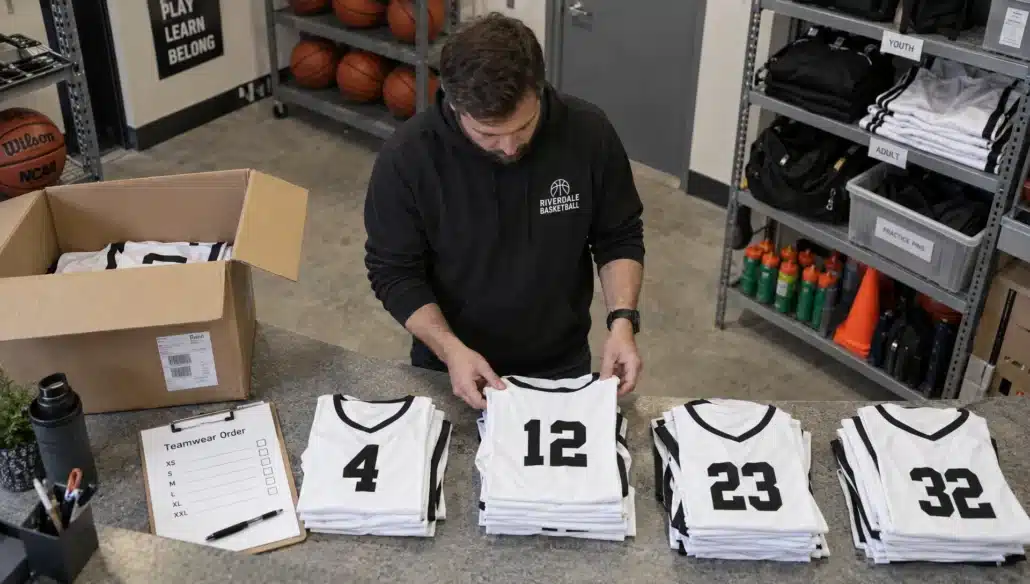
Before paying an NBA jersey manufacturer for samples or bulk production, ask one question: What written authorization permits this specific order? A factory may produce excellent basketball uniforms without having permission to reproduce NBA logos, team branding, player identities or Nike trademarks. Manufacturing capability and licensing authority are separate issues.
For brands, retailers and team buyers, the goal is to verify who holds the relevant rights, what those rights cover and whether your order falls within them. A supplier’s product photos or promise of “official quality” cannot establish that permission.
Use the questions below before approving artwork or paying a production deposit. This is a sourcing checklist, not legal advice; have qualified intellectual property counsel review any proposed licensed merchandise arrangement.
What an NBA Jersey Manufacturer’s Licensing Status Actually Means
The word licensed needs context. A business might hold a merchandise license, manufacture for a licensee or simply resell genuine finished products. Those arrangements do not provide the same permissions.
| Supplier’s role | What you need to establish | What you should not assume |
|---|---|---|
| Custom clothing manufacturer | Its ability to produce your authorized design | That production capability includes NBA rights |
| Merchandise licensee | The products, territories and activities its license permits | That its rights cover every team, channel or buyer |
| Approved subcontract manufacturer | Its authorization to fulfill the licensee’s specific production order | That it can sell licensed goods independently |
| Authorized distributor | Its right to distribute the relevant genuine products | That it can commission new branded designs |
An NBA jersey manufacturer should explain its role clearly before discussing protected artwork. The NBA’s terms of use also make clear that accessing league content does not grant a general license to use its trademarks or other protected material.
1. Who Granted the Rights, and Can We Verify Them?
Ask for the legal name of the rights holder or licensing counterparty, the supplier’s contracting entity and the entity placing the production order. These names should connect through a documented authorization chain.
The manufacturer does not necessarily need to hold a direct league license. It may legitimately produce goods for a licensee under an approved subcontracting arrangement. What matters is whether that arrangement covers your transaction, rather than an unrelated customer’s previous order.
Request relevant authorization documents, including the permitted activity, validity period and any conditions on subcontracting. If commercial terms are confidential, ask whether redacted documentation or direct confirmation from the licensing counterparty can establish the necessary facts.
Do not rely solely on a certificate sent through a messaging app. Verify the authorization through an independently sourced contact, not just an email address supplied in the document.
A credible NBA jersey manufacturer should be willing to explain how verification can occur, even when confidentiality limits what it can share. Refusal to disclose royalty rates is different from refusal to identify who authorized production.
2. Does the Permission Cover Our Products, Markets and Sales Channels?
A valid license can still be unsuitable for your order. Ask whether the authorization covers the exact product category, such as adult replica jerseys, youth apparel or another defined merchandise category. Permission for one category does not establish permission for every basketball-related product.
Then identify where the goods will be manufactured, imported, marketed and sold. Buyers serving the United States, Canada, Europe, Australia or Brazil should not assume that authorization for one market extends worldwide. Germany and Poland may sit within an agreed European territory, but the contract’s actual wording controls.
Sales channels also matter. Wholesale distribution, a brand’s own website, online marketplaces and physical retail may be treated differently under the agreement. Ask who is permitted to sell and whether your business must be specifically approved.
Give the NBA jersey manufacturer a written order summary covering the product, quantity, buyer, destination markets and intended channels. Ask for confirmation against that summary. A vague assurance of “international shipping available” says nothing about the scope of merchandising rights.
Also check whether any restrictions apply to promotional giveaways, institutional purchases or sales bundled with other products.
3. Who Clears Team Logos, Player Names and Other Branding?
A jersey can contain several independently controlled elements. League branding, team marks, player names and likenesses, apparel-brand logos and sponsor marks should not be treated as one permission package.
Ask the supplier to identify which elements are covered by its authorization and which require separate clearance. Player-related rights may involve individual agreements or applicable group licensing arrangements. THINK450, the NBPA’s commercial arm, is a relevant organization for understanding NBA player group licensing, but its role does not mean that every proposed use is automatically covered.
Nike’s logo is another separate issue. Permission to manufacture a basketball jersey does not, by itself, authorize adding a swoosh or a label implying Nike origin. The same caution applies to sponsor patches and special-event graphics.
Your NBA jersey manufacturer should review the complete artwork, including neck labels, hangtags and packaging, rather than approving only the front chest design.
For an original teamwear project, establish your own identity instead of reproducing professional-team branding. Our guide to basketball jersey design features covers the practical design decisions to make once the rights position is clear.
4. What Approvals Are Required Before Sampling and Production?
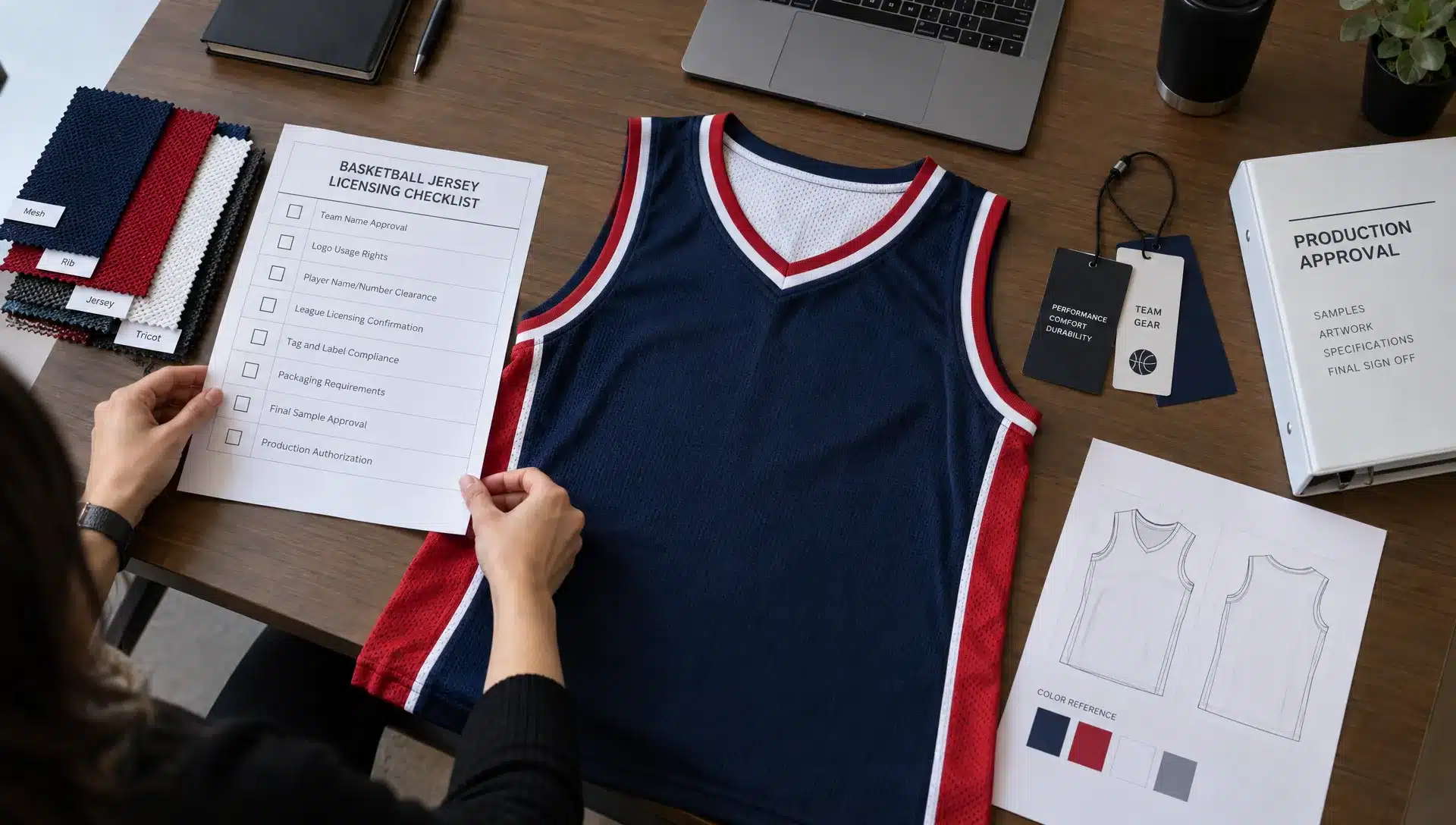
Ask the manufacturer to describe the approval process in order: artwork submission, any required development authorization, physical sampling, revisions and final production release. The sequence depends on the applicable licensing agreement.
Find out who can approve each stage and what evidence records that approval. A buyer’s sign-off on fabric or sizing is not necessarily a rights holder’s approval of the branding. Likewise, approval of an earlier jersey does not automatically cover a new colorway or commemorative patch.
Request a version-controlled artwork file and written approval tied to the relevant sample. The production order should identify that approved version so the factory does not use an obsolete file.
Ask the NBA jersey manufacturer whether sampling itself is authorized and how rejected samples must be handled. A “sample only” label is not a substitute for permission to reproduce protected material.
Finally, separate approval time from manufacturing time. A quote should explain when the production lead time begins and what happens if revisions are required. Do not base a launch date solely on sewing capacity when licensing approval remains unresolved.
5. Which Licensing Responsibilities Will Be Written Into the Contract?
Verbal assurances are difficult to enforce when a shipment is delayed or challenged. Before paying a deposit, ask the supplier to identify the contractual responsibilities of the buyer, manufacturer and any licensee involved.
The agreement should accurately state who supplies the artwork, who secures the necessary permissions and who obtains required approvals. It should also address what happens if authorization expires, is withdrawn or proves insufficient for the proposed order.
Discuss record retention, access to approval evidence and responsibility for unauthorized substitutions. If the factory changes a production site or decoration subcontractor, determine whether further approval is required.
Ask your NBA jersey manufacturer how the contract handles disputed goods, relabeling, rework, cancellation and disposal. Have counsel review warranties, indemnities, liability limits and dispute-resolution terms rather than assuming a broad “supplier guarantee” protects you.
Import risk deserves separate attention. U.S. Customs and Border Protection’s intellectual property guidance explains its enforcement role concerning infringing imports. Other destinations have their own requirements. Passing a quality inspection does not establish that goods can lawfully enter or be sold in the destination market.
6. What Happens With Reorders, Leftover Stock and Expiring Rights?
Licensing checks should continue after the first successful shipment. Ask whether a reorder needs fresh authorization and whether the license will remain valid through production, delivery and the intended selling period.
A contract may distinguish between the last date for manufacturing and any permitted sell-off period. Do not assume that stock can be sold indefinitely because it was produced while a license was active. Obtain the applicable terms before committing to inventory.
Also ask how the factory controls overruns, rejected garments, unused labels and packaging. Establish who owns these materials, how quantities are reconciled and what must happen to surplus branded items. An approved production run should not become an undocumented source of additional merchandise.
A responsible NBA jersey manufacturer should connect each repeat order to current authorization, approved artwork and the relevant purchase order. Consistency involves both the garment specification and the permission to make it.
For the production side of repeat buying, our article on how basketball apparel manufacturers handle team reorders explains why retaining the original specifications matters. Licensing checks are an additional requirement, not a replacement for those records.
Licensing Red Flags That Should Pause an Order
A low price or fast sample should not outweigh missing authorization. Pause the purchase if the supplier cannot resolve any of these issues:
- Photos replace documentation: Previous NBA-branded work is presented as the only evidence of permission.
- Rights are described as unlimited: The supplier claims it can make any team, player or branded design for any market without checking scope.
- Labels are offered as proof: Holograms, hangtags or branded packaging are treated as substitutes for an authorization trail.
- The paperwork contradicts the product: The invoice describes unbranded uniforms while the goods carry protected branding, without a credible explanation and accurate documentation.
These warning signs justify further checks, not automatic accusations. A legitimate supplier may need time to obtain confirmation from its customer or licensing counterparty. What matters is whether it resolves the question before production proceeds.
If an NBA jersey manufacturer cannot establish permission for your order, the safer commercial alternative is an original jersey design using branding you own or are authorized to use. Removing one logo or changing a few colors does not necessarily resolve every remaining rights issue.
For an own-brand project, discuss an original teamwear design before developing protected professional-team artwork.
Frequently Asked Questions
Does Nike make all NBA uniforms? Nike supplies the NBA’s official on-court uniforms under its league partnership. That relationship does not make every basketball jersey factory an authorized supplier. It also does not grant unrelated manufacturers permission to reproduce Nike, NBA or team branding.
Can I order NBA-style jerseys without a license? You can commission original basketball jerseys, but “NBA-style” is not a legal exemption. Whether permission is needed depends on the actual design, branding and intended use. Have potentially protected elements reviewed before ordering rather than relying on the product description.
Does calling a jersey a replica make it licensed? No. “Replica” describes a product type or positioning, not proof of authorization. An NBA jersey manufacturer offering replicas should still establish the relevant rights and permitted distribution arrangement.
How long does a licensed jersey order take? There is no universal timeline. Artwork review, licensing approvals, sampling, materials and production all affect delivery. Ask for separate milestones and make sure the quoted manufacturing lead time states which approvals must be complete before it starts.
Start With the Rights Position, Then Request a Quote
Before approaching a supplier, prepare a short brief stating whether you want authorized licensed merchandise or original custom teamwear. Include your artwork ownership, product requirements, quantities, destination markets and intended sales channels.
Extreme Sportswear offers custom sportswear manufacturing, private-label production, cut-and-sew services and decoration options including sublimation, screen printing and embroidery. Those manufacturing services should not be treated as evidence of NBA licensing. Any proposed use of protected branding requires separately verified authorization.
For original basketball apparel or a project supported by appropriate permissions, request a custom jersey quote and provide your design and production requirements for discussion.