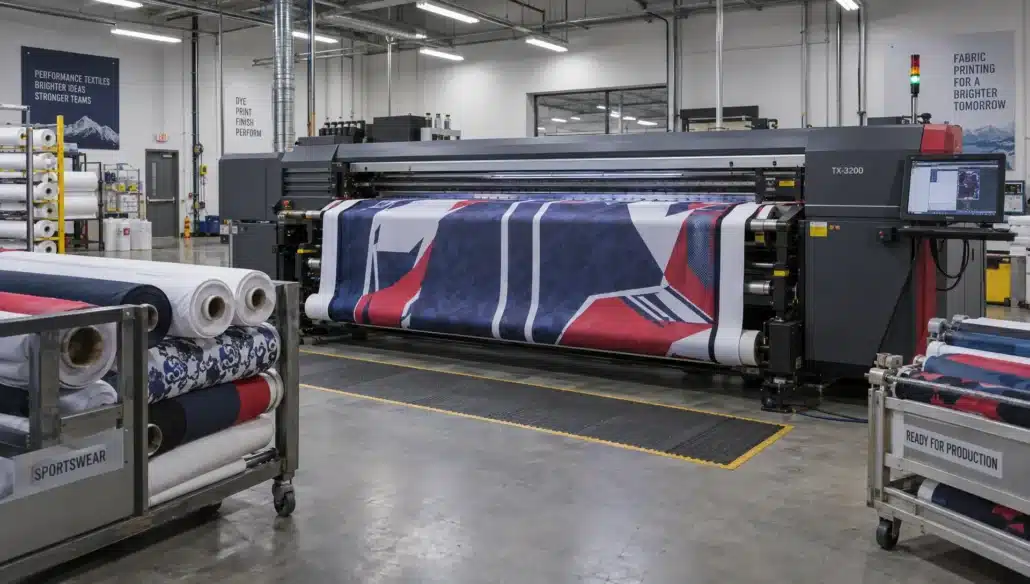
The price of sportswear printing depends on more than the logo on a jersey. Two orders with the same quantity can cost differently because of the fabric, decoration method, artwork, personalization and production schedule. A low headline price may also exclude setup, samples or delivery.
For teams, gyms and private-label brands buying from overseas, the useful comparison is not simply “price per print.” It is the cost of producing the approved design on the specified garment, with all required charges clearly identified.
These seven factors explain where costs come from, which expenses you can reduce and what to include when requesting a quote.
1. Printing Method and Setup Requirements
Different printing processes divide costs differently between preparation and production. A method with a higher setup charge may become economical over a larger run, while another may suit a small order better.
Screen printing typically requires screens and preparation for each print color at each location. Once production starts, that setup can be spread across the order. A simple design repeated on many garments can therefore have different economics from several small batches with different artwork.
Dye sublimation uses a different workflow. It is commonly used for polyester sportswear, including all-over designs printed onto fabric panels before sewing. Adding another design color does not normally create the same separate-screen requirement, although artwork preparation, printed area and production work still affect cost.
When comparing sportswear printing methods, ask whether the quote covers decoration on a finished garment or printed fabric panels plus garment assembly. Those are not equivalent scopes.
Our comparison of sublimation and screen printing explains the technical trade-offs. For budgeting, first establish the suitable process, then compare its complete cost.
2. Order Quantity and How the Run Is Split
Larger orders can reduce the setup cost allocated to each piece, but the total quantity alone does not tell the whole story. What matters is how many garments share the same production requirements.
An order of 200 identical training shirts is different from 200 shirts divided across ten separate sponsor designs. The second order may require additional artwork handling, screens, production changes or sorting, depending on the process.
Size variation does not automatically mean a new print setup. However, youth and adult garments may need different artwork dimensions to maintain suitable proportions. Separate garment colors can also require changes to ink selection or the printing sequence.
Ask whether minimum order quantities apply per style, design, fabric color or overall purchase. Also distinguish a supplier's minimum order from the quantity at which a particular process becomes economical.
To control sportswear printing costs, consolidate genuinely identical production work rather than simply increasing the order. Buying unwanted stock to reach a lower unit price can cost more than the discount saves. Request a reorder quote too, since a smaller follow-up batch may have different setup economics.
3. Fabric Composition, Garment Color and Stretch
The fabric determines which printing processes are suitable and what precautions production may require. A quote based on a generic “sports shirt” leaves too much room for assumptions.
Polyester, cotton blends and stretch fabrics do not behave identically under heat or ink. Standard dye sublimation works best on suitable polyester substrates and does not print white ink. The underlying fabric color therefore affects the result, which is why white or light-colored polyester is commonly used.
For other printing processes, dark garments may need an underbase to make the design sufficiently opaque. Some dyed polyester fabrics also require measures to control dye migration, where garment dye affects the printed area during or after heat exposure.
Stretch adds another requirement. A decoration on fitted leggings or a compression top must accommodate the movement expected at that location. Mesh texture, water-repellent finishes and heat-sensitive materials can introduce further limitations.
Specify fiber composition, fabric weight, garment color and stretch requirements before requesting a firm price. If the fabric changes after approval, the original printing specification may no longer be suitable. A cheaper decoration is not a saving if it cracks, distorts or changes color on the chosen material.
4. Artwork, Coverage and Sportswear Printing Locations
A small chest logo and a full-front graphic use different amounts of space, materials and production time. Adding sleeve marks, back sponsors or a second decorated panel can introduce further handling and setup.
Color count matters particularly for screen printing. Four spot colors may require more preparation than one, while gradients or photographic artwork can need a different separation approach. For sublimation, additional design colors do not generally carry the same per-color setup structure, but artwork complexity and printed area still matter.
Placement also changes the job. Printing near seams, across zippers or onto hard-to-access areas can require different equipment or production sequencing. A design printed on flat panels before sewing should not be priced as though it were a simple application to a finished shirt.
Define artwork size and position, not just the logo itself. A quote request should state dimensions and locations, such as a 90 mm-wide left-chest mark and a 280 mm-wide back graphic.
To reduce cost, question each additional location. Removing a sleeve sponsor nobody requires may be more sensible than compromising the durability of the main team crest.
5. Player Names, Numbers and Other Variable Details
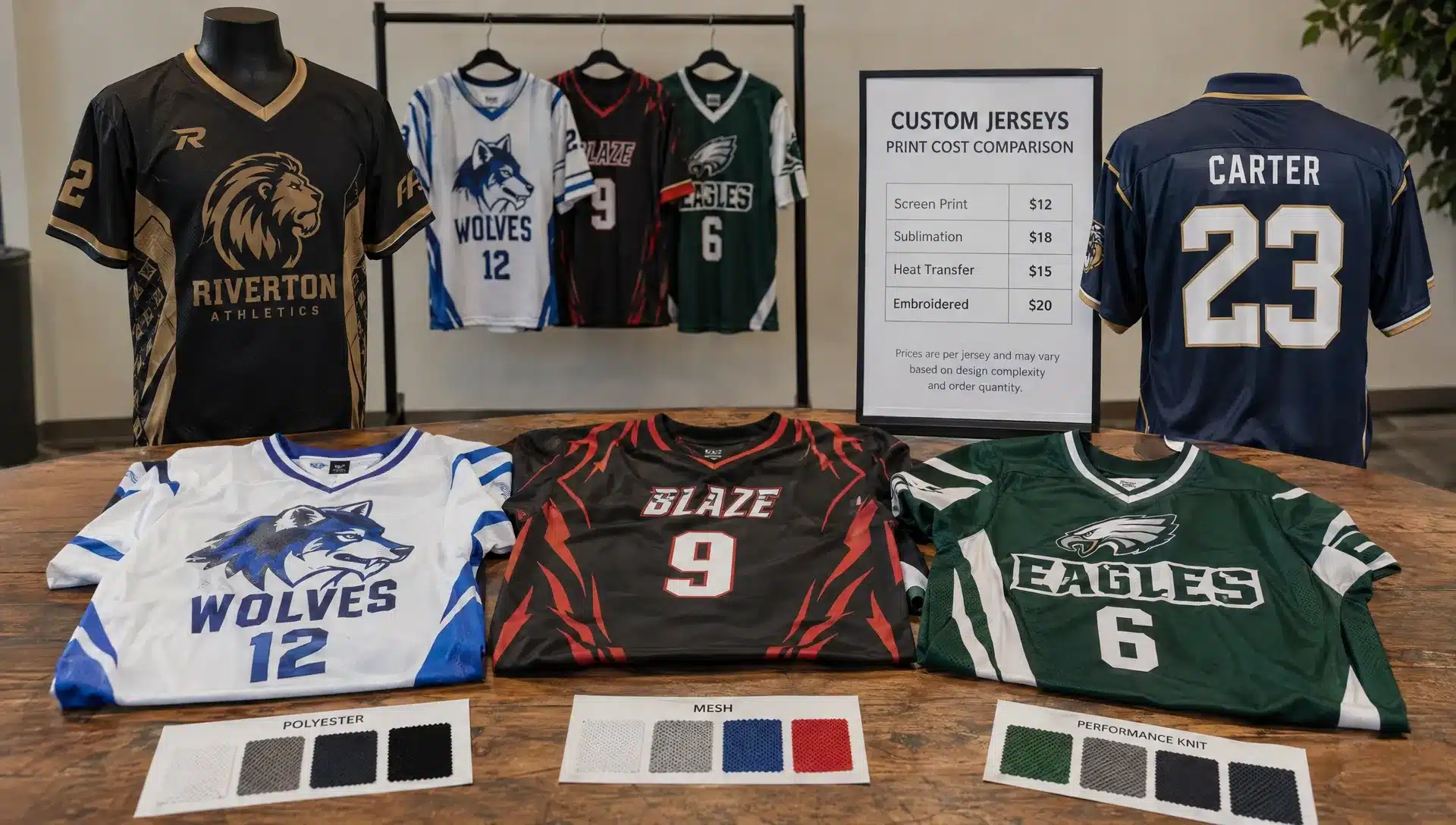
Personalization turns one repeated design into a set of individual production instructions. Even when the base jersey stays the same, names, numbers and other variable details must be prepared, checked and matched to the correct garment.
Depending on the process, a supplier may incorporate those details into sublimated artwork or apply them separately. Either way, the work includes data handling and quality control, not just the physical decoration.
Ask whether names and numbers are included in the quoted sportswear printing price. If they are charged separately, establish whether the charge is per garment, per placement or based on another defined unit. Do not assume different suppliers use the same pricing structure.
Submit one approved roster with consistent spelling, capitalization, sizes and number formatting. Late changes can require revised artwork or replacement pieces, especially once printing or cutting has begun.
For league orders, confirm number dimensions and placement requirements before approving the design. Correcting a noncompliant number after production can cost far more than checking the specification beforehand. Keep a dated copy of the approved roster so both buyer and manufacturer work from the same version.
6. Artwork Preparation, Sampling and Testing
A production-ready file and a small image copied from a website are not equivalent inputs. Artwork may need to be redrawn, separated into print colors, resized or adapted to garment panels before manufacturing can begin.
Vector files are often useful for logos, while photographic designs require sufficient resolution at the intended print size. Ask which file formats the manufacturer accepts and whether artwork preparation is included. Avoid assuming that every file labeled “print ready” meets that supplier's requirements.
Sampling also affects sportswear printing costs, but it can reveal problems before they reach the full order. A digital mockup helps confirm layout; it does not prove color, stretch behavior, print feel or wash performance on the actual fabric.
Distinguish between a print swatch, a decorated stock garment and a fully constructed pre-production sample. Each answers different questions, so compare like-for-like sampling quotes. Confirm whether sample revisions and courier charges are additional.
Before approving production, prepare your sample brief with this custom sportswear sampling checklist. Record the accepted artwork, fabric and decoration details together, so an approved logo is not accidentally treated as approval of the entire garment.
7. Deadlines, Packaging and Delivery Scope
A short deadline can reduce production flexibility. Depending on capacity and material availability, meeting it may require expedited sourcing, changes to scheduling or faster shipping. Rush service is not always available, so confirm feasibility before committing to an event date.
Work backward from the date garments must arrive, allowing for artwork approval, sampling, manufacturing, inspection and transit. A dispatch date is not an arrival date, and delayed approvals can consume the available production window.
Packaging and sorting requirements can also change the order total. Individual bags, custom labels, player-specific packing and carton separation by team may involve additional materials or labor.
These charges should be distinguished from sportswear printing itself. For international purchases, request a clear delivery basis and identify who pays freight, insurance where applicable, import duties, taxes and customs-clearance charges. Their treatment depends on the destination and agreed shipping terms.
Compare quotes in the same currency and on the same delivery basis. A lower factory price may not produce a lower delivered cost. Ask for the quote's validity period too, particularly when fabric sourcing, exchange rates or shipping arrangements remain unconfirmed.
How to Compare Quotes Without Being Misled by Unit Price
Ask each supplier to separate recurring production costs from one-time charges. The basic calculation is:
Print cost per garment = (setup charges + total production printing charges + required printing extras) ÷ quantity.
For illustration only, suppose setup costs $120 and the production print charge is $2 per garment. These hypothetical figures are not Extreme Sportswear prices or market estimates.
| Order quantity | Setup charge | Production printing | Total printing cost | Printing cost per garment |
|---|---|---|---|---|
| 50 | $120 | $100 | $220 | $4.40 |
| 100 | $120 | $200 | $320 | $3.20 |
| 250 | $120 | $500 | $620 | $2.48 |
The example shows how spreading setup changes sportswear printing cost per piece, even without a volume discount on the production charge. The total bill still rises as quantity increases.
For a complete garment comparison, add the garment price and all applicable sampling, personalization, packaging and delivery charges. Keep import costs separate where the supplier cannot confirm them. Compare both the total order commitment and the cost per usable garment, rather than choosing on the lowest headline figure alone.
Frequently Asked Questions
Which printing method is cheapest for sportswear? There is no universal cheapest option. Quantity, fabric, artwork and placement determine the suitable process and its economics. Screen printing can suit repeated designs, while sublimation may suit polyester garments with extensive coverage or integrated personalization. Compare equivalent finished specifications.
Does using fewer colors always reduce the price? No. Fewer print colors can reduce screen-printing preparation, but sublimation does not normally use a separate screen for each color. Ask which design changes actually affect your quote before simplifying artwork unnecessarily.
Why can a small reorder cost more per piece? A smaller batch may spread preparation and administration across fewer garments. Material availability and production scheduling may also differ. Confirm whether previous artwork or screens can be reused and which charges will apply again.
What should I send for an accurate quote? Send the garment style, fabric specification, quantities by size, artwork files, print dimensions, locations, personalization requirements, packaging instructions, delivery destination and required arrival date. State whether you need printing on supplied garments or complete custom manufacturing.
Get a Quote Based on Your Actual Order
A useful quote makes assumptions visible. Define the garment, decoration and delivery requirements first, then ask which changes would reduce cost without weakening performance or design quality.
Extreme Sportswear offers custom sportswear manufacturing, cut-and-sew production, sublimation, screen printing and private-label customization, with low-MOQ orders and sampling available. Confirm the minimums, sample requirements and lead time for your specific project.
To discuss a complete manufacturing order, contact Extreme Sportswear with your artwork, quantities and destination. Ask for setup, personalization, sampling and shipping to be itemized so you can compare the proposal on a clear basis.