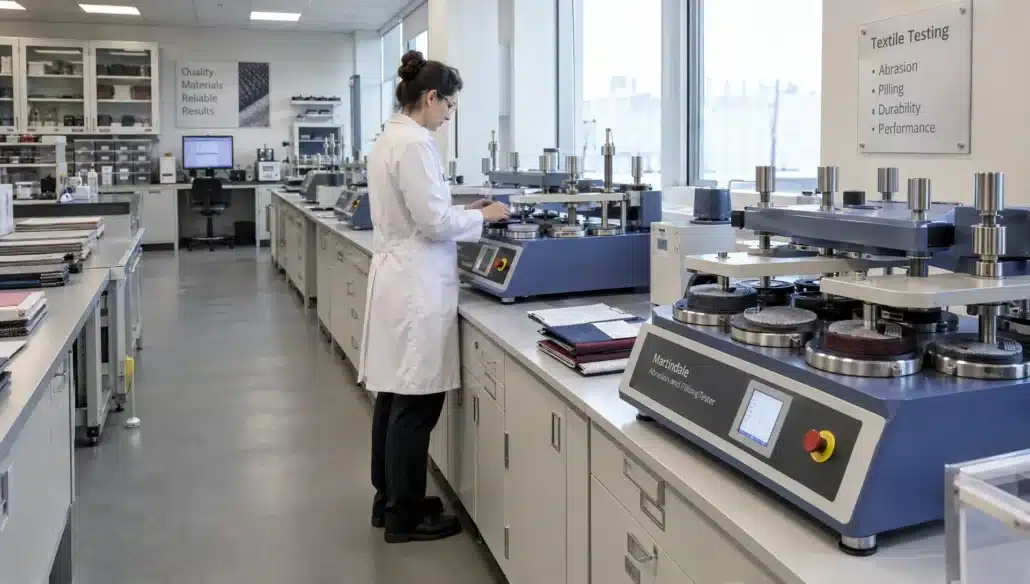
A sample can look excellent and still lose shape, transfer dye or stay uncomfortably wet during training. Before approving performance clothing for bulk production, request test results that show how the actual fabric and finished garment behave under defined conditions.
For brands, teams and private-label buyers, the most useful evidence connects a test method to an agreed acceptance limit. A supplier’s statement that a material is “moisture-wicking” or “durable” is not enough. You need to know what was tested, how it was tested and whether the result meets your product specification.
The five checks below provide a practical starting point for everyday sportswear and activewear.
Agree on the test plan before approving samples
Testing should begin with the intended use. Lightweight running tops, stretch leggings and contact-sport jerseys face different demands, so they should not automatically share identical acceptance limits.
Record the fabric composition, construction, weight, color, finish and decoration method. Identify whether the laboratory will receive fabric, decorated panels or finished garments. Put these details in your fitness-apparel tech pack alongside the agreed methods and pass/fail criteria.
Set acceptance limits before reviewing results. Otherwise, a disappointing number can become an argument about what “good quality” means.
For independent testing, ask whether the laboratory’s ISO/IEC 17025 accreditation scope covers the relevant method. Accreditation supports confidence in testing competence; it does not certify the garment itself. Confirm the applicable method edition with the laboratory rather than copying an old reference from another supplier’s report.
1. Test how performance clothing moves moisture
Moisture-management testing checks how liquid wets, spreads through and transfers across a fabric. It helps distinguish useful sweat-handling behavior from an unsupported marketing claim.
A relevant method is AATCC TM195, published by AATCC. It evaluates liquid moisture-management properties under controlled conditions. Ask the laboratory to identify the intended skin-facing side, particularly for fabrics with different inner and outer surfaces.
What to request and how to judge it
Request the individual measurements and directional results, not just a supplier-selected overall rating. Compare candidate materials using the same method, conditioning and preparation. A fabric’s finish can affect results, so test the production-intended material rather than an unrelated showroom swatch.
For performance clothing sold with a quick-drying claim, add a separate drying-rate method, such as AATCC TM201 where appropriate. Liquid transport and drying speed are related properties, but they are not interchangeable.
Set approval criteria around the product’s use and, where useful, a tested reference fabric. For a running top, you may prioritize liquid spreading and drying behavior. For a garment worn beneath another layer, transfer away from the skin-facing surface may deserve more attention.
Do not interpret a moisture-management result as proof of breathability. Air permeability and water-vapor resistance require different measurements. If those properties support your sales claims, include suitable additional testing rather than stretching the meaning of this result.
2. Measure stretch and recovery, not just stretch
A fabric that stretches easily may still develop bagging at the knees, elbows or seat. Stretch measures extension under specified conditions. Recovery describes how well the material returns afterward, while residual growth reveals the deformation left behind.
For performance clothing with stretch panels or a close fit, request measurements in both relevant fabric directions. Record the applied load, extension or holding time and recovery interval so results can be interpreted correctly.
What to request and how to judge it
ASTM D2594 addresses stretch properties of knitted fabrics having low power. It is not a universal method for every elastic textile. Ask the laboratory to select the appropriate method for the construction and intended use, using standards from ASTM International or another agreed standards body.
Your report should distinguish initial stretch from residual growth. Two fabrics can reach a similar extension while showing very different recovery afterward.
Compare results with the pattern’s requirements. A close-fitting garment needs sufficient extension for movement, but fabric recovery must also support the intended silhouette. Stretch percentage alone cannot establish whether the finished garment fits correctly.
Where repeated laundering is a concern, request an agreed comparison before and after washing. Keep the wash procedure and recovery conditions consistent. For compression products, stretch testing alone does not establish delivered pressure or substantiate medical claims; those require a separate evaluation plan.
3. Check colorfastness to perspiration
Sweat can cause visible shade changes or transfer color onto adjacent materials. The risk matters for dark leggings, contrasting team uniforms and garments with pale linings or panels.
ISO 105-E04 evaluates colorfastness to perspiration using specified acidic and alkaline solutions. The method assesses both color change in the specimen and staining of adjacent fabric.
For performance clothing, request those two results separately. A material may retain an acceptable appearance while still staining another textile during exposure.
What to request and how to judge it
Ask for the tested colorway, specimen identification and numerical grades. In the relevant gray-scale assessments, higher grades indicate better performance, with 5 representing the best grade. Agree on acceptable grades for color change and staining before the test.
Use representative production colors. Passing results for a pale shade do not automatically establish the performance of a deep navy, red or black made with a different dye recipe.
Include decorated specimens when printing or other surface treatments could affect the outcome. A report on undecorated fabric cannot establish how a finished graphic will behave.
Perspiration testing does not replace every other colorfastness check. If dye transfer during contact is a concern, request wet and dry rubbing tests, such as ISO 105-X12. Laundering colorfastness is another separate consideration. Select these additions according to the garment’s risks rather than treating one passing report as evidence of all-round color durability.
4. Evaluate pilling resistance
Pilling develops when fibers form small surface balls through wear and friction. It can make an otherwise functional garment look worn early, especially around underarms, thighs and areas that rub against equipment.
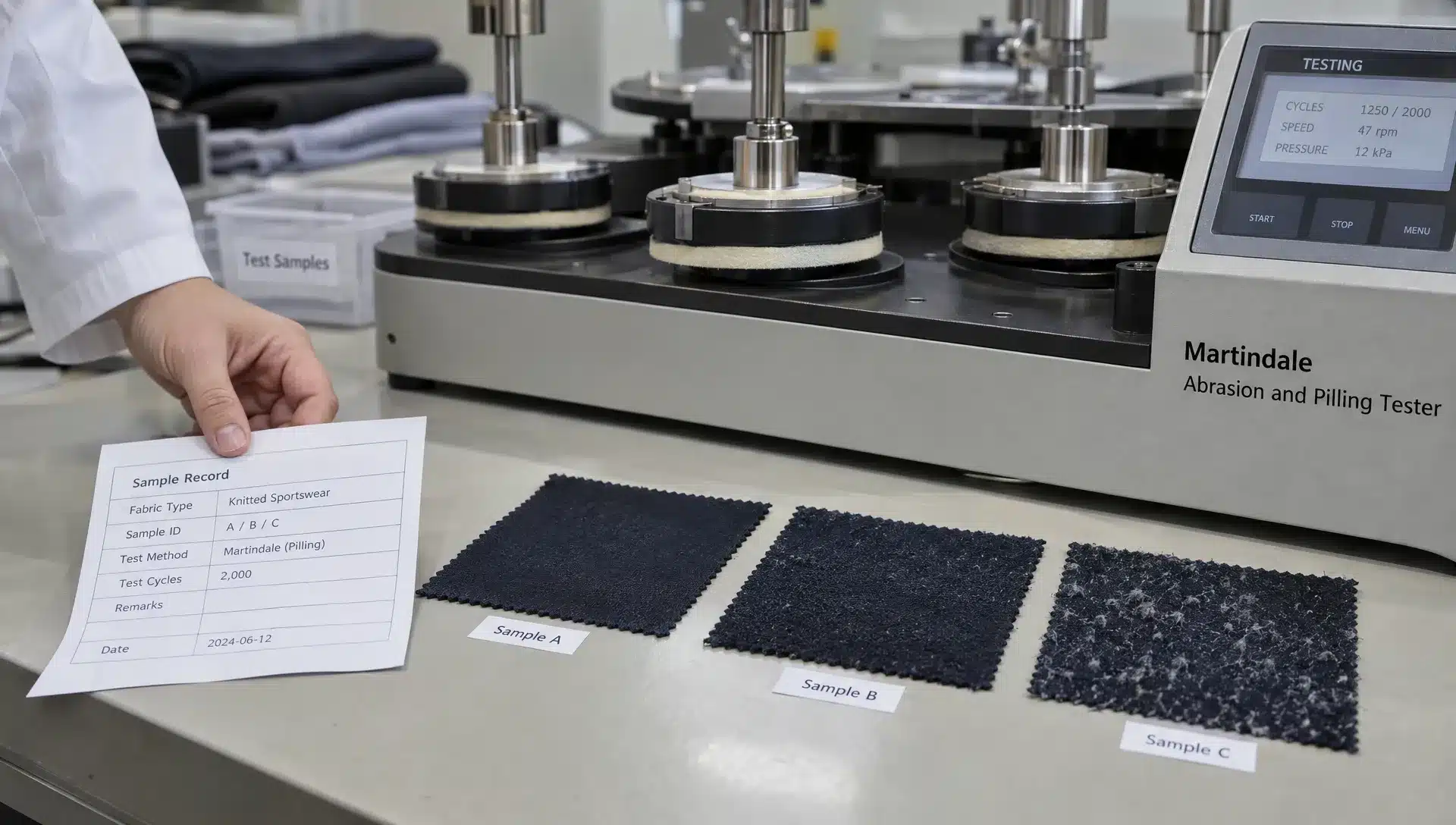
ISO 12945-2 uses a modified Martindale method to assess fabric propensity to surface pilling, fuzzing or matting. Results depend on the specified procedure and assessment stage, so the grade needs its testing conditions attached.
What to request and how to judge it
Ask for the assessment intervals, final grade and clear specimen photographs. Pilling grades generally run from 1 to 5, with 5 indicating the best appearance. Compare materials only when the method and conditions match.
For performance clothing, define the acceptable appearance at agreed test stages rather than requesting a vague “anti-pilling finish.” A finish is a manufacturing treatment, not proof that the finished material meets your requirement.
Check the surface that will face outward in use. Brushed, textured and smooth fabrics may behave differently, and a result from another construction is not a reliable substitute.
Pilling resistance is not abrasion resistance. A fabric may retain a clean surface yet wear through under repeated rubbing. For products exposed to equipment, rough surfaces or concentrated friction, discuss a separate abrasion test, such as ISO 12947-2. Do not interpret the laboratory’s rubbing cycles as a guaranteed number of training sessions or months of wear.
5. Verify dimensional stability after washing
Washing can change garment length, width and fit even when the fabric feels unchanged. This test checks whether the approved dimensions remain within tolerance after a defined care procedure.
A common approach combines ISO 6330 washing and drying procedures with ISO 5077 measurement of dimensional change. The laboratory can confirm the applicable procedures through the ISO standards catalog.
What to request and how to judge it
Use a procedure consistent with the proposed care instructions and agree on the number of wash-and-dry cycles. Report actual percentage changes rather than simply stating “wash tested.”
For example, a marked length that changes from 50 cm to 49 cm has a dimensional change of −2%. That calculation describes shrinkage; whether it passes depends on your agreed tolerance.
For performance clothing, test finished garments as well as fabric where construction could affect fit. Specify measurement points such as body length, chest width, inseam and waistband dimensions. Different materials in the same garment may shrink differently, producing puckering or distortion.
Inspect appearance after washing too. Record twisting, seam puckering, print cracking and trim damage separately from dimensional measurements. These observations add useful evidence, but they do not replace dedicated seam-strength or print-durability testing when needed.
Approve the care instructions only after considering the results. A gentle laboratory wash cannot substantiate durability under a harsher washing process that your label permits.
Require a report that supports a production decision
A test report is useful only when you can connect it to the material you intend to buy. Ask for specimen photographs or identifiers, the fabric reference, colorway, finish and sample date.
For performance clothing, a passing result from a different fabric weight, dye recipe or finishing process may not represent the proposed order. Traceability matters as much as the headline grade.
| Report field | What it should establish |
|---|---|
| Specimen identity | The tested material or garment matches the approved specification |
| Method and conditions | The standard, preparation and relevant test settings are identifiable |
| Results | Actual values or grades are reported, including separate directions or assessments where relevant |
| Acceptance criteria | The buyer’s agreed limits are recorded alongside the results |
| Decision and follow-up | Approval, corrective action or retesting is clearly documented |
For an initial screen, a supplier’s internal checks can help identify obvious problems. Where a claim, commercial risk or buyer requirement needs independent evidence, obtain testing from a suitable laboratory.
If a specimen fails, identify the cause before changing the specification. A revised finish, dye process or fabric construction can affect several properties, so agree which checks must be repeated after correction.
Connect sample approval to the bulk order
Development testing does not automatically cover every later production lot. Establish what changes trigger review, such as a new fabric mill, altered blend, different finish or revised decoration process.
Use a risk-based plan to decide whether to retest first-bulk material, selected colorways or later lots. Keep an approved reference sample and ensure purchasing documents identify the same specification used for testing.
The custom sportswear sampling checklist can help organize the physical sample review alongside these laboratory checks. Fit, workmanship and artwork approval still matter; laboratory results do not replace them.
These five checks also do not establish regulatory compliance for every destination. Depending on the market and product, fiber labeling, chemical restrictions, flammability or other requirements may apply. UV-protection, antimicrobial and protective-performance claims need their own supporting evidence.
Frequently asked questions
Do all five tests need an independent laboratory? Not necessarily. Internal testing can support development and routine control. Use independent testing when your claim, buyer specification or risk assessment calls for it, and verify that the laboratory can perform the relevant method.
What is a passing result for performance clothing? There is no universal threshold covering every garment. Set limits for the intended activity, fabric construction, fit and care instructions before testing. Where possible, use a tested reference product to make comparisons meaningful.
Can one fabric report cover every color and print? Not automatically. Dyes, finishes and decoration processes can change results. Ask the laboratory which variants need separate testing or a justified representative sampling plan.
Should testing happen before or after the final sample? Begin with material testing during development, then evaluate production-intended materials and finished samples where relevant. Resolve failures before bulk approval and agree on any first-bulk verification before the order proceeds.
Discuss your pre-production requirements
Extreme Sportswear offers custom sportswear, private-label production, cut-and-sew services and low-MOQ orders, with fabric, decoration and packaging customization.
For your next performance clothing project, share the intended activity, target markets, fabric preferences and proposed acceptance criteria. Ask how the sampling plan can accommodate the checks you need, including any independent laboratory work, before confirming production.