Sportswear brands used to treat sustainability as a nice brand story. Today, it is becoming a commercial advantage. Buyers want activewear that performs, looks sharp and carries a clearer responsibility message. Retailers want supply chains they can explain. Teams and fitness communities want apparel that feels good to wear and good to represent.
That is why sustainable activewear can build value beyond a single product launch. It can improve trust, protect margins, strengthen customer loyalty and make a brand easier to sell across markets. For founders, private-label buyers, gym apparel brands and teamwear companies, sustainability works best when it is designed into the product strategy from the start, not added as a marketing label at the end.
The goal is not to sound perfect. The goal is to build a brand that customers, retailers and partners can believe in over time.
Why sustainable activewear creates long-term brand value
Brand value grows when customers trust that a company makes good decisions repeatedly. In activewear, those decisions show up in the fabric, fit, durability, finishing, packaging and claims printed on the product page.
Sustainable activewear supports that trust because it connects product quality with brand responsibility. A recycled polyester training top that loses shape after three washes does not build value. A thoughtfully made garment with the right stretch recovery, clean stitching, responsible material choices and honest messaging can.
This is where sustainability becomes practical. It can help a brand:
- Stand out in crowded activewear categories
- Justify premium pricing through better materials and production choices
- Reduce waste from overproduction, poor sampling and weak fit development
- Build stronger relationships with retailers and corporate buyers
- Improve repeat purchase by delivering products that last
For brands selling in the USA, Canada, Europe, Australia, Germany, Poland or Brazil, the same idea applies across different markets. Customers may express sustainability expectations differently, but they usually respond to a clear product promise: apparel that performs well, lasts longer and is made with better choices behind it.
The market has moved from preference to expectation
Sustainability used to be a niche appeal. Now it influences sourcing, wholesale approvals, brand partnerships and customer reviews. A gym apparel brand may be asked about fabric content. A teamwear buyer may want lower-waste production. A retailer in Europe may request more documentation about materials and supply chain practices.
Regulation is also shaping expectations. The European Commission explains that the Corporate Sustainability Reporting Directive expands sustainability reporting requirements for many large and listed companies, which can affect suppliers through documentation requests. In the United States, the FTC Green Guides warn brands against broad environmental claims that are not properly qualified.
For activewear companies, this does not mean every new brand needs a complex compliance department. It means your product story should be specific, accurate and backed by real manufacturing choices. If you use recycled fabric, say what is recycled. If you reduce waste through lower MOQs or made-to-order production, explain that clearly. If your packaging is customized with a lower-waste approach, make the claim precise.
Clear claims protect trust. Vague claims create risk.
What sustainable activewear actually means
Sustainable activewear is not one material, one certification or one slogan. It is a combination of design and manufacturing choices that reduce waste, support durability and create a more responsible supply chain.
Organizations such as Textile Exchange focus on preferred fibers and materials, while the Ellen MacArthur Foundation highlights circular fashion principles such as keeping products in use and reducing waste. For activewear brands, those ideas translate into practical decisions.
| Sustainability area | What it means for activewear | How it builds brand value |
|---|---|---|
| Preferred materials | Recycled, organic or lower-impact fabric options where suitable | Gives customers a clearer reason to choose the brand |
| Durability | Strong seams, reliable stretch recovery and color retention | Reduces returns and improves repeat purchase |
| Smarter production | Low MOQ, accurate sampling and controlled production runs | Limits overstock and cash tied up in unsold inventory |
| Responsible decoration | Sublimation, screen printing or embroidery chosen for the garment use case | Protects product appearance and performance |
| Packaging choices | Custom packaging with less unnecessary material where possible | Improves unboxing without adding avoidable waste |
| Honest claims | Specific product descriptions and traceable details | Builds credibility with buyers and customers |
The most valuable brands do not treat sustainability as separate from quality. They make it part of the product standard.
How sustainability improves positioning and pricing power
A brand earns pricing power when customers understand why its product costs more and why it is worth buying again. Sustainable activewear can support that story because it gives substance to the premium.
A higher price feels more reasonable when the garment has better construction, a more intentional fabric choice, cleaner finishing and a believable responsibility message. This is especially true for private-label activewear, boutique gym collections, corporate wellness apparel and premium teamwear.
If your brand is planning its first launch, sustainability should not lead to an overloaded product range. A small, focused capsule is usually stronger than a large collection with weak consistency. The same principle applies to building a strong first activewear collection: define the buyer, choose the use case and make every style support the same brand promise.
Sustainability also works closely with perceived quality. If the garment feels premium in hand, fits well and carries a responsible message, the customer has fewer reasons to compare it only on price. For brands moving toward higher-value products, the connection between sustainability and premium activewear brand positioning can be especially powerful.
Where manufacturing choices make or break the strategy
Sustainable activewear is built before the product reaches a website or retail shelf. It starts with the manufacturer brief: fabric selection, pattern development, sampling, decoration, trims, packaging and production quantity.
Extreme Sportswear is a Pakistan-based custom clothing manufacturer specializing in sportswear, activewear, teamwear and private-label apparel. For brands that need cut-and-sew production, low MOQ orders, fast sampling, sublimation printing, screen printing, embroidery, uniform manufacturing, fabric customization and packaging customization, the manufacturing stage is where sustainability becomes practical.
The strongest briefs connect sustainability with product performance. A recycled fabric is only useful if it suits the activity. A low MOQ is only valuable if the brand uses it to test demand rather than overproduce. Custom packaging only helps if it improves the customer experience without unnecessary excess.
| Manufacturing decision | Question to ask | Brand value impact |
|---|---|---|
| Fabric selection | Does this material match the sport, climate and target price point? | Better comfort, fewer returns and clearer product positioning |
| Sampling | Can the sample confirm fit, stretch, stitching and finish before bulk production? | Lower risk and more consistent product launches |
| MOQ planning | Can the first run be sized to real demand? | Less deadstock and better cash flow |
| Decoration method | Should the design use sublimation, screen printing or embroidery? | Longer-lasting branding and stronger visual identity |
| Packaging | Can packaging be customized without excess material? | Better presentation and a cleaner sustainability story |
| Quality control | Are seams, sizing and finishing consistent across production? | More trust, stronger reviews and repeat orders |
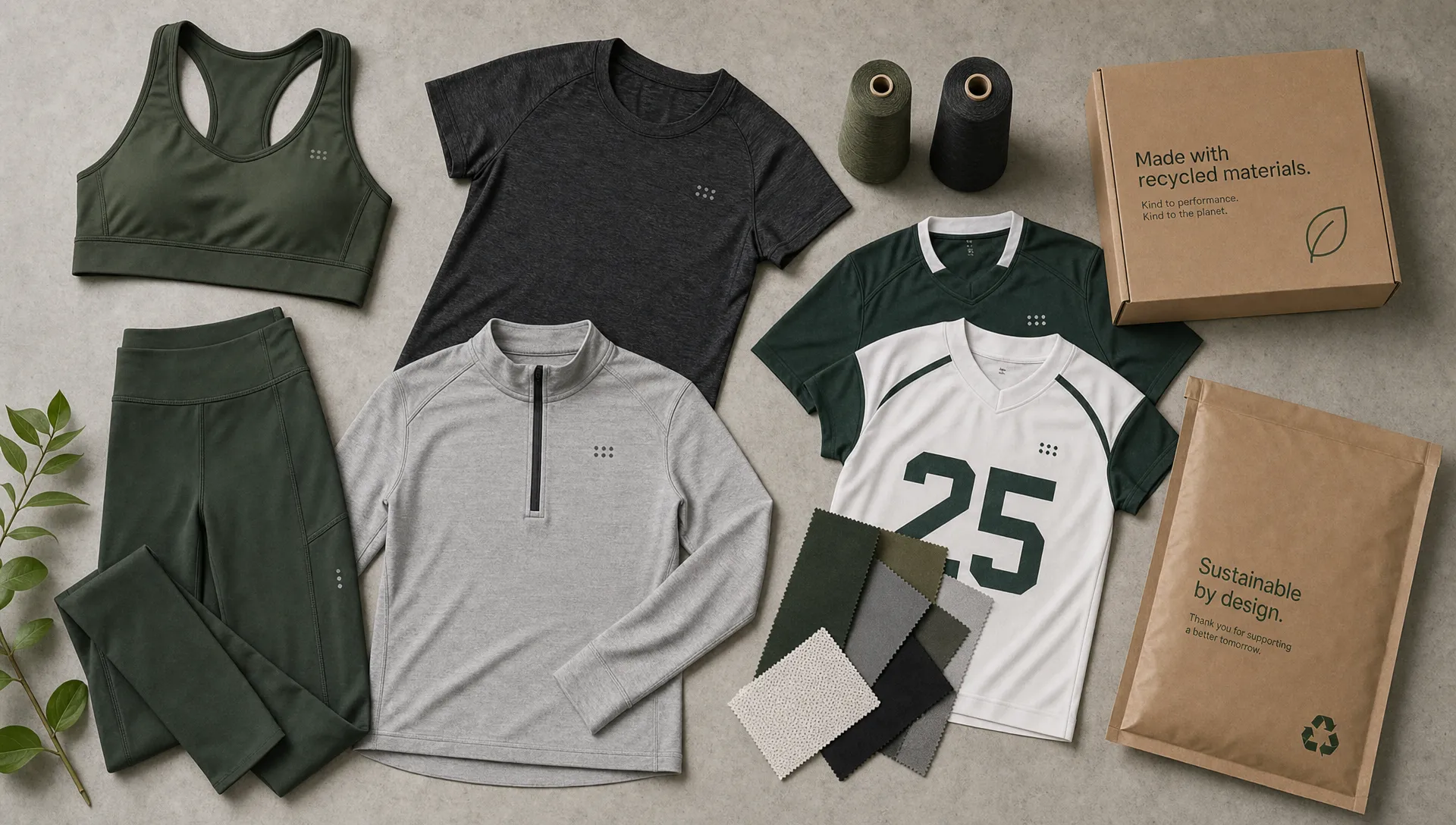
Sustainable activewear must still perform
Performance is the reason activewear exists. Sustainability cannot compensate for poor stretch, weak stitching, uncomfortable fabric or inconsistent sizing. A responsible product that fails during training damages brand value faster than a conventional product that performs well.
The best approach is to match sustainability goals to the product use case. A yoga set needs softness, opacity and stretch recovery. A football training kit needs breathability, color durability and freedom of movement. A corporate wellness hoodie may need comfort, embroidery compatibility and a finish that looks professional after repeated washing.
This is why fabric and construction decisions should be tested early. Buyers still care about the practical sports clothing features that matter most, including comfort, durability, decoration quality and size consistency. Sustainability strengthens those features when it is part of the same development process.
For example, sublimation can work well for vibrant teamwear designs because the print becomes part of the fabric surface rather than sitting heavily on top. Embroidery can elevate caps, polos and corporate sportswear, but it needs the right fabric weight and placement. Screen printing can suit certain graphics, but the artwork, ink choice and garment use case should be planned together.
A sustainable activewear line should never ask customers to choose between values and performance. The long-term value comes from delivering both.
How sustainability supports international brand growth
Different markets create different pressures. A brand selling in Germany or Poland may face more questions about documentation because EU buyers are increasingly attentive to sustainability claims. A brand selling in the USA may need claims that are specific and easy to verify. In Canada and Australia, outdoor lifestyle and fitness communities often respond well to durability and practical comfort. In Brazil, climate, movement and bold visual identity can make breathable fabrics and strong decoration choices especially important.
The product strategy should adapt without losing the core brand promise.
| Market focus | Common buyer expectation | Practical activewear strategy |
|---|---|---|
| USA | Clear value, performance and credible claims | Use specific product descriptions and avoid broad green claims |
| Canada | Comfort, durability and versatile lifestyle use | Prioritize fabric feel, wash resistance and all-day wearability |
| Europe | Documentation, responsible sourcing and product quality | Keep material details, production notes and claim language organized |
| Germany and Poland | Practical quality, pricing logic and supplier reliability | Focus on consistency, fit accuracy and transparent production choices |
| Australia | Breathability, outdoor comfort and active lifestyle appeal | Choose fabrics suited to heat, movement and frequent washing |
| Brazil | Color, movement, comfort and expressive branding | Combine performance fabrics with strong sublimation or print execution |
Sustainability helps international growth when the claim is flexible but the standards are consistent. Customers do not need the same message in every market, but they do need the same level of product reliability.
Metrics that show sustainable activewear is building value
A sustainability strategy should be measured like any other brand investment. If the products are improving trust and commercial performance, you should see signs across customer feedback, sales behavior and buyer conversations.
| Metric | What to track | Why it matters |
|---|---|---|
| Repeat purchase rate | How often customers return for another item or collection | Shows whether quality and brand trust are converting into loyalty |
| Return reasons | Fit, fabric feel, stitching, transparency, sizing or color issues | Identifies whether product development is supporting the brand promise |
| Sell-through rate | How quickly a production run sells through | Helps reduce overproduction and plan smarter MOQs |
| Review language | Mentions of comfort, quality, durability, packaging or sustainability | Reveals what customers actually value |
| Wholesale feedback | Questions from retailers, gyms, clubs or corporate buyers | Shows whether the brand is ready for larger accounts |
| Deadstock level | Unsold inventory after a launch or season | Measures whether production planning is becoming more efficient |
These metrics turn sustainability from a vague intention into a business system. Over time, they show which materials, fits, designs and production choices create the most durable value.
Common mistakes that weaken sustainable brand value
Many activewear brands want to become more sustainable, but the execution can easily become too broad or too expensive. The most common mistake is leading with claims before the product is ready. A sustainability message cannot fix poor sizing, weak finishing or late production planning.
Another mistake is assuming one fabric choice defines the whole brand. Materials matter, but durability, fit, sampling, packaging, MOQ planning and communication matter too. A brand that produces too many SKUs, orders too much inventory and makes vague environmental claims may still create waste, even if one fabric has a better story.
Brands should also avoid copying sustainability language from competitors. Customers and retailers are becoming more sensitive to generic claims. Simple, specific language is stronger. Instead of saying an item is eco-friendly, explain the material choice, the production approach or the durability benefit in plain terms.
A final mistake is separating sustainability from design. If the collection does not look desirable, the product will not sell. Unsold sustainable products still become inventory problems. Long-term value comes from responsible products that customers genuinely want to wear.
A practical roadmap for building sustainable activewear value
Start with a focused product concept. Choose the activity, buyer, climate and price position before selecting fabric. A gym set, football uniform, running top and corporate wellness hoodie all need different performance standards.
Next, build a smaller collection with clear roles for each style. Use sampling to test fit, stretch, decoration and finishing before bulk production. If you are a new brand, low MOQ production can help you validate demand without committing too much capital to inventory.
Then refine the product story. Keep claims specific and connected to real choices. If your value is durability, show it through construction and customer care guidance. If your value is lower-waste production planning, explain how controlled order quantities help reduce excess. If your value is material selection, be precise about the fabric and why it was chosen.
Finally, make sustainability part of your repeat system. Track what sells, what gets returned, what customers praise and what buyers ask for. The more feedback you collect, the better your next production run becomes.
This is how sustainable activewear compounds brand value: one reliable product, one clear claim and one better production decision at a time.
Frequently Asked Questions
What makes activewear sustainable? Sustainable activewear is made through better material choices, durable construction, responsible production planning, accurate sampling, lower-waste packaging and honest product claims. It should also perform well for its intended activity.
Is sustainable activewear more expensive to produce? It can cost more depending on fabric, trims, decoration and order quantity, but smarter sampling and low MOQ production can reduce financial risk. The goal is to improve long-term value, not just reduce unit cost.
Can sustainable activewear still be high performance? Yes. The key is choosing fabrics and construction methods that match the use case. Stretch recovery, breathability, stitching strength, opacity and decoration durability should be tested before bulk production.
How can a new brand start with sustainable activewear? Start with a focused collection, use low MOQ production where possible, test samples carefully and make only specific claims you can support. A small, well-developed launch is usually stronger than a large, unfocused range.
What should brands ask a manufacturer before production? Ask about fabric options, sampling timelines, MOQ, cut-and-sew capabilities, printing or embroidery methods, packaging customization and quality control. The answers will show whether the manufacturer can support both performance and sustainability goals.
Build sustainable activewear with long-term value in mind
Sustainable activewear can become one of your strongest brand assets when it is built into the product, not added as a slogan. With the right manufacturer, your brand can create custom sportswear, activewear, teamwear or private-label apparel that supports performance, trust and repeat business.